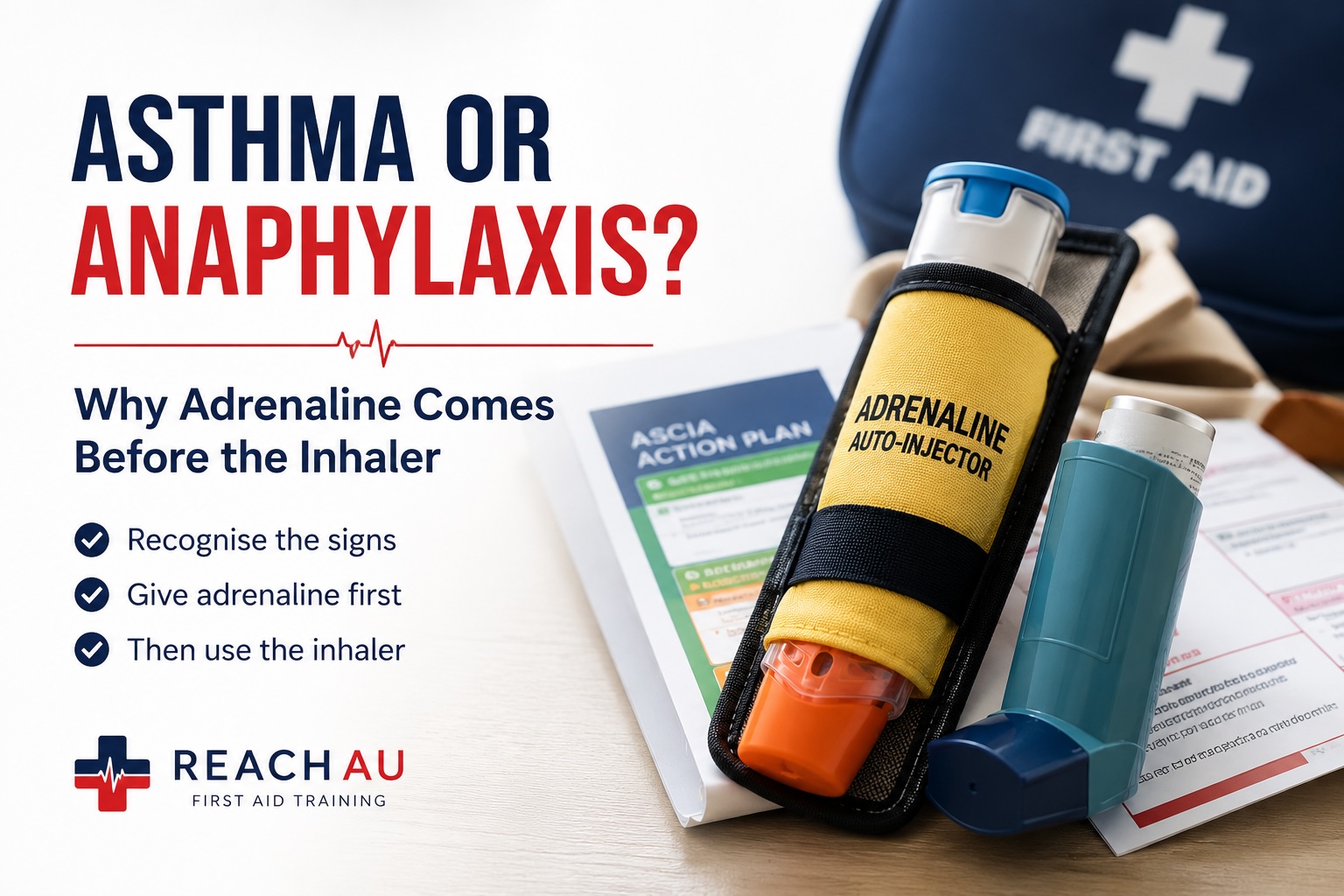
Asthma or Anaphylaxis? Why Adrenaline Comes Before the Inhaler
When someone has both asthma and a known allergy, sudden breathing difficulty requires a specific and immediate response: give adrenaline first, then the asthma reliever. This article explains why that order matters, what signs to look for in an emergency, and how to prepare so that you or the people around you can act correctly when it counts.
Asthma and anaphylaxis are two different conditions that can look similar in an emergency, especially in people who have both. A person who wheezes when exposed to a food or insect allergen may appear to be having an asthma episode. But if they have a known allergy, that wheeze could be anaphylaxis. Reaching for the reliever puffer without giving adrenaline first can cost critical time. Australian allergy guidance from ASCIA is unambiguous: adrenaline comes first, even when there are no visible skin symptoms like hives or swelling.
This guide covers the clinical reasoning behind the adrenaline-first rule, the specific signs that should trigger it, step-by-step emergency actions, the risk of biphasic anaphylaxis, and what workplaces, schools and families need to have in place. It is written for anyone who lives with, cares for or works alongside people who have both asthma and allergy, and for those who want to be prepared before an emergency happens.
The information in this article draws on ASCIA clinical guidelines, ANZCOR recommendations, guidance from Allergy and Anaphylaxis Australia, and the findings from the Victorian coronial inquest into the death of James Tsindos, which was delivered in February 2026. That inquest specifically identified the failure to administer adrenaline before the asthma reliever, and the lack of recognition of biphasic anaphylaxis, as contributing factors in the outcome. The case underscores why training, preparation and correct emergency protocols are not optional for anyone who works with or cares for people at risk of anaphylaxis.
Anaphylaxis & Allergy
Asthma or Anaphylaxis? Why Adrenaline Comes Before the Inhaler
If someone has both asthma and a known allergy, sudden breathing difficulty must be treated as anaphylaxis first. The order of treatment is not a preference. It is clinical guidance that can determine the outcome.
Most people are used to reaching for the blue reliever puffer when they hear wheezing, coughing, chest tightness or shortness of breath. That makes sense when the problem is asthma.
But when asthma and allergy overlap, the situation changes.
Australian allergy and anaphylaxis guidance is clear: if someone with known asthma and a known allergy to food, insects or medication develops sudden breathing difficulty, give adrenaline first, then the asthma reliever. This applies even if there are no skin symptoms.
This is one of the most important emergency rules people need to understand. Because in the moment, hesitation can cost time. And in anaphylaxis, time matters.
Quick Answer
If a person has known asthma and a known allergy, and they suddenly develop breathing difficulty:
▶ Give the adrenaline autoinjector first.
▶ Then give the asthma reliever.
▶ Call 000 for an ambulance.
Do not wait for a rash. Do not wait to see if the puffer works first. Sudden wheeze, persistent cough, hoarse voice or breathing difficulty can be signs of anaphylaxis, even without skin symptoms.
What this article covers:
✓ Why asthma and anaphylaxis get confused in an emergency
✓ The clinical rule on adrenaline first and why it exists
✓ What to do step by step when breathing symptoms appear in someone with asthma and allergy
✓ Hidden allergy risks including vegan food and alpha-gal syndrome
✓ Biphasic anaphylaxis and why "they look better" is not the end
✓ What workplaces, schools and community groups need to have in place
Allergy & Anaphylaxis Awareness Week
This week we are raising funds for Allergy & Anaphylaxis Australia
Every dollar raised supports education, research and advocacy for the millions of Australians living with serious allergies. If this article matters to you, please consider contributing.
Donate to Support Allergy & Anaphylaxis Awareness
1 Why Asthma and Anaphylaxis Get Confused in an Emergency
Asthma is familiar. People know what wheezing sounds like. They know what a reliever puffer is for. They may have used one many times before.
That familiarity can become a problem.
In an allergic emergency, breathing symptoms can look like asthma. The person may wheeze. They may cough. They may feel tight in the chest. They may struggle to speak.
But if the cause is anaphylaxis, the body is not just having a lung problem. It is having a severe allergic reaction that can affect the airway, breathing, circulation, skin and gut simultaneously.
A reliever puffer can help open the lower airways, but it does not treat the full allergic reaction. Adrenaline does.
Why adrenaline works when a puffer does not.
Adrenaline helps reduce airway swelling, opens the airways, supports blood pressure and helps reverse the life-threatening effects of anaphylaxis. The Australian Commission on Safety and Quality in Health Care states that other medicines, including asthma medicines and antihistamines, should only be used after adrenaline when anaphylaxis is present. That is why the order matters.
2 The Rule for When Asthma and Allergy Overlap
If the person has all three of the following:
✓ Known asthma
✓ A known allergy to food, insects or medication
✓ Sudden breathing difficulty, wheeze, persistent cough or hoarse voice
Treat it as anaphylaxis. Give adrenaline first, then the asthma reliever.
This applies even if:
✗ There is no rash
✗ There are no hives
✗ The person says it feels like asthma
✗ You are not completely sure
✗ The person has used a puffer before in similar situations
ASCIA Clinical Guideline
"ALWAYS GIVE ADRENALINE FIRST, then asthma reliever if someone with known asthma and allergy to food, insects or medication has SUDDEN BREATHING DIFFICULTY (including wheeze, persistent cough or hoarse voice) even if there are no skin symptoms."
ASCIA (Australasian Society of Clinical Immunology and Allergy), cited in the Victorian coronial finding into the death of James Tsindos, February 2026 (COR 2021 002798).
If you are unsure whether it is asthma or anaphylaxis, use the adrenaline autoinjector first. Healthdirect states it is better to use adrenaline than delay treatment for a serious reaction.
3 Why People Hesitate to Use Adrenaline
People often hesitate because they are worried about giving adrenaline unnecessarily.
They worry it will be too strong. They worry they will hurt the person. They worry they will make the wrong call.
That hesitation is understandable, but it is also dangerous.
Giving adrenaline when it wasn't needed
Adrenaline is not dangerous for asthma. Guidance from Allergy & Anaphylaxis Australia confirms that using an adrenaline device is not harmful for asthma and can help open the airways. There is no penalty for acting.
Delaying adrenaline in anaphylaxis
This is where lives are lost. ANZCOR states that early administration of adrenaline is the priority in emergency treatment. A delay allows the reaction to progress and reduces the chance of recovery.
The bigger risk is not giving adrenaline when it is needed.
This is why first aid training needs to go beyond "use the puffer for asthma" and "use the autoinjector for anaphylaxis". Real emergencies are not always that neat.
4 The Wheezing Trap: Asthma Symptoms That Can Mask Anaphylaxis
Wheezing can mislead people. Because it is so strongly linked with asthma, people may automatically reach for the reliever puffer.
But wheezing can also occur during anaphylaxis. So can:
▸ Persistent cough
▸ Hoarse voice
▸ Throat tightness
▸ Difficulty breathing
▸ Swelling of the tongue or throat
▸ Collapse
▸ Pale and floppy appearance in children
▸ Sudden deterioration after exposure to a known allergen
The dangerous assumption.
"It must be asthma because they are wheezing." That assumption can delay adrenaline. If allergy is part of the picture, sudden breathing symptoms need to be treated as anaphylaxis first.
Ambulance Victoria Clinical Practice Guideline
"Asthma, food allergy and high risk of anaphylaxis frequently occur together, often in adolescence. Bronchospasm is a common presenting symptom in this group, raising the likelihood of mistaking anaphylaxis for asthma. A history of asthma increases the risk of fatal anaphylaxis."
Ambulance Victoria Clinical Practice Guideline A0704, cited in the Victorian coronial finding into the death of James Tsindos, February 2026 (COR 2021 002798).
Victorian Coronial Finding, February 2026
James Tsindos was 17 years old when he died from anaphylaxis in May 2021. He had known asthma and a tree nut allergy. When he arrived at an emergency department after a severe allergic reaction, he began to wheeze. A bedside nurse administered a Ventolin puffer instead of adrenaline.
The Safer Care Victoria Root Cause Analysis found a "lack of staff knowledge on recognising and treating biphasic anaphylaxis" and specifically identified the failure to follow the principle of "administering adrenaline first, then asthma reliever" as a contributing factor in the outcome.
Coroners Court of Victoria, Finding into Death with Inquest, COR 2021 002798. Coroner Sarah Gebert, delivered 20 February 2026.
5 What to Do When Breathing Symptoms Appear in Someone With Asthma and Allergy
This is not the time to debate whether it is "really asthma" or "really anaphylaxis". If asthma and allergy are both in the history and sudden breathing difficulty is happening, adrenaline comes first.
Step | Action | Detail |
|---|---|---|
1 | Give adrenaline first | Use the person's adrenaline autoinjector (EpiPen or Anapen) according to device instructions and their ASCIA Action Plan if available. |
2 | Call 000 for an ambulance | Anaphylaxis is a medical emergency. Do not wait to see if they improve before calling. Call immediately. |
3 | Position the person safely | Lay them flat and keep them still. Do not allow them to stand or walk. If breathing is difficult, they may sit with legs outstretched. |
4 | Give the asthma reliever after adrenaline | Follow asthma first aid after the adrenaline has been given. Not before. The order matters. |
5 | Give a second dose if needed | If symptoms do not improve after 5 minutes, give another adrenaline autoinjector if available. |
6 | Start CPR if required | If the person becomes unresponsive and is not breathing normally, start CPR and follow emergency operator instructions. |
6 Why Skin Symptoms Are Not Required to Diagnose Anaphylaxis
A lot of people expect anaphylaxis to look like a rash. That is a problem.
Yes, hives, redness, swelling and itching can happen. But anaphylaxis can also present with serious breathing symptoms, collapse or sudden deterioration without any obvious skin symptoms.
Critical point: Waiting for a rash can delay treatment. ASCIA guidance specifically states that adrenaline should be given first for sudden breathing difficulty in someone with known asthma and allergy, even if there are no skin symptoms. No rash does not mean no anaphylaxis.
7 Hidden Allergy Risks: Why Assumptions Can Be Dangerous
Allergy triggers are not always obvious. Some people react to foods or ingredients that others would not think twice about. Some allergens are hidden in sauces, desserts, processed foods, medications or supplements.
This is why emergency plans, clear communication and training matter. Two examples worth understanding are vegan foods and alpha-gal syndrome.
Vegan Food Is Not Automatically Allergy-Safe
Vegan food may be dairy-free or egg-free, but it can still contain high-risk allergens such as cashew, almond, macadamia, peanut, sesame, soy, coconut, lupin and other tree nuts. Vegan cheeses, creamy sauces, desserts and protein products may use nuts or seeds as substitutes.
For someone with a severe allergy, the word "vegan" does not mean "safe".
The only safe approach is to check the actual ingredients, understand cross-contamination risk, and follow the person's allergy management plan.
Real-World Example: Victorian Coronial Finding, February 2026
James Tsindos had a known tree nut allergy. On the day of his reaction, he ordered a Burrito Bowl from a vegan restaurant via a food delivery app. The dish contained a "nacho cashew cheese" which was a cashew-based vegan substitute for dairy cheese.
The coroner found that the delivery app only displayed truncated ingredient information. The word "cashew" appeared, but only after selecting the full listing for the meal item. The assumption that vegan food would be nut-free was not made by James, but the situation highlights how hidden allergens in vegan products can be a serious and under-recognised risk.
Maria Said AM, CEO of Allergy & Anaphylaxis Australia, gave evidence at the inquest noting that vegan food is commonly assumed to be safe for nut-allergic individuals but frequently contains nuts, and that online food ordering is a growing source of anaphylaxis incidents.
Coroners Court of Victoria, COR 2021 002798, Coroner Sarah Gebert, February 2026.
Alpha-gal Syndrome and Mammalian Meat Allergy
Alpha-gal syndrome, also known as mammalian meat allergy, is different from many food allergies because reactions can be delayed and unpredictable. It is associated with tick bites and can cause allergic reactions to mammalian meat and mammalian-derived products including beef, pork, lamb, gelatine and other mammal-derived ingredients.
The tricky part is that reactions may not happen every time. A person may tolerate a food on one occasion and react on another.
This is why people with known allergy risks need a current medical plan, and why bystanders need to know how to respond if anaphylaxis occurs regardless of the trigger.
8 Biphasic Anaphylaxis: Why "They Look Better" Is Not the End
Anaphylaxis can improve after treatment and then return. This is called biphasic anaphylaxis.
It means symptoms can come back after the first reaction appears to have settled, without another exposure to the allergen. This is one reason ambulance care and medical observation matter even after an initial improvement.
Who is at higher risk of biphasic reactions?
Australian Prescriber notes that prolonged and biphasic reactions may occur. It recommends observation for at least 4 hours after the last dose of adrenaline, with longer observation recommended for people who:
▸ Had a severe reaction or needed repeated doses
▸ Have asthma
▸ Have a history of protracted anaphylaxis
▸ Live alone or are remote from medical care
Victorian Coronial Finding: Biphasic Anaphylaxis
James Tsindos was treated by paramedics at the scene and received two doses of intramuscular adrenaline. He was then transported to hospital. Despite initial treatment, he developed a biphasic anaphylactic reaction at the emergency department and went into cardiac arrest approximately one hour and fifteen minutes after arrival.
Despite ECMO intervention, he was declared brain dead and died on 29 May 2021. The coronial finding specifically identified the failure to administer adrenaline first at the emergency department, and the lack of staff recognition of biphasic anaphylaxis, as contributing factors in the outcome.
If someone improves after adrenaline, that is good. But it does not mean the emergency is over. They still need medical care and observation.
9 Why Carrying Two Adrenaline Autoinjectors Matters
One dose may not be enough. If symptoms continue after 5 minutes, another adrenaline dose may be needed. This is why many people at risk of anaphylaxis are advised to carry two adrenaline autoinjectors.
This matters even more in regional, rural or remote areas of Western Australia where ambulance response times may be longer.
If you, your child, your staff member or someone in your care has a known allergy, check:
✓ Do they have a current ASCIA Action Plan?
✓ Is the plan easy to access?
✓ Are their adrenaline autoinjectors in date?
✓ Do they carry two devices if recommended?
✓ Do the people around them know where the devices are?
✓ Do those people know how to use them?
✓ Does the plan clearly explain what to do if asthma and allergy symptoms overlap?
Do not leave this until an emergency.
10 Workplaces, Schools and Community Groups: What You Need in Place
If your workplace, school, childcare service, sporting club or community group has people with asthma and allergy risks, you need more than paperwork. You need people who can act.
That means:
✓ Knowing where action plans are kept
✓ Knowing where medication is stored and checking expiry dates
✓ Recognising breathing symptoms as a possible anaphylaxis sign
✓ Giving adrenaline first when asthma and allergy overlap
✓ Calling 000 early, not after waiting to see if things improve
✓ Keeping the person still
✓ Preparing for a second dose
✓ Starting CPR if required
People do not rise to the occasion in an emergency.
They fall back on what they have practised. That is why practical first aid training matters, and why it needs to cover the asthma and anaphylaxis overlap specifically, not just the textbook versions of each condition in isolation.
11 Questions to Ask Your Doctor About Asthma and Anaphylaxis Plans
If you or someone in your care has both asthma and allergy, ask your doctor or nurse practitioner the following at your next appointment.
"If sudden breathing difficulty happens, does the emergency plan clearly say to give adrenaline first, then the asthma reliever?"
Also ask:
✓ Should two adrenaline autoinjectors be carried?
✓ When should a second dose be given?
✓ Where should the ASCIA Action Plan be kept?
✓ Who needs a copy of the plan?
✓ Does the school, workplace or activity provider understand the plan?
✓ Is the asthma plan aligned with the anaphylaxis plan?
These questions are not overreacting. They are preparation.
The Final Takeaway
If asthma and allergy overlap, sudden breathing difficulty is anaphylaxis until proven otherwise.
Remember:
▶ Give adrenaline first.
▶ Then give the asthma reliever.
▶ Call 000.
▶ Keep the person still.
▶ Prepare for a second dose.
▶ Do not wait for a rash. Do not rely on guesswork.
The goal is not to panic people. The goal is to train people well enough that they can take the first correct action when it matters.
Training and assessment is delivered by Britt at Regional Education and Career Help Australia on behalf of ABC First Aid RTO 3399.
Frequently Asked Questions
Should you give an inhaler or adrenaline first during an allergic reaction?
If someone has known asthma and a known allergy to food, insects or medication and develops sudden breathing difficulty, adrenaline should be given first, then the asthma reliever. This applies even if there are no skin symptoms such as hives or rash.
Can anaphylaxis look like asthma?
Yes. Anaphylaxis can cause wheeze, persistent cough, hoarse voice, throat tightness and breathing difficulty, all of which can look and sound like asthma. In someone with known asthma and allergy, sudden breathing difficulty should be treated as anaphylaxis first.
Do you need to see a rash before treating anaphylaxis?
No. Anaphylaxis can occur without obvious skin symptoms. If a person with known asthma and allergy develops sudden breathing difficulty, do not wait for a rash before using adrenaline. Waiting for skin signs can delay life-saving treatment.
What is biphasic anaphylaxis?
Biphasic anaphylaxis is when symptoms return after the first reaction appears to have improved, without another exposure to the allergen. This is one reason people need ambulance care and medical observation after anaphylaxis, even if they seem to have recovered.
Why might someone need two adrenaline autoinjectors?
A second dose of adrenaline may be needed if symptoms do not improve after 5 minutes. People at risk of anaphylaxis, and especially those in rural or remote areas where ambulance response times are longer, should follow their medical advice and current ASCIA Action Plan regarding carrying two devices.
Is vegan food always safe for people with allergies?
No. Vegan food may still contain common allergens such as tree nuts, peanuts, sesame, soy or lupin. People with allergies need to check actual ingredients and cross-contamination risk rather than relying on the word vegan as an indicator of safety.
What is alpha-gal syndrome?
Alpha-gal syndrome, also known as mammalian meat allergy, is associated with tick bites and can cause delayed and unpredictable allergic reactions to mammalian meat or mammal-derived products such as gelatine. People with this condition should follow medical advice and carry a current allergy action plan.
Allergy & Anaphylaxis Awareness Week
Support Allergy & Anaphylaxis Awareness in Australia
Cases like James Tsindos remind us that anaphylaxis awareness saves lives. Allergy & Anaphylaxis Australia provides education, resources and advocacy for the millions of Australians at risk.
If this article has been useful to you, please consider supporting their work during Allergy and Anaphylaxis Awareness Week.
Donate Now and Support Awareness
Learn First Aid Before You Need It
Anaphylaxis and asthma emergencies can move quickly. The right training helps you recognise the signs, follow the correct order of treatment and act with confidence when it matters.
REACHAU delivers practical, empowerment-focused First Aid training across Western Australia, including group and workplace bookings.
HLTAID009 CPR | HLTAID011 Provide First Aid | HLTAID012 Education and Care | HLTAID013 Remote First Aid | HLTAID014 Advanced First Aid