Tetris, Trauma Memory and Psychological First Aid
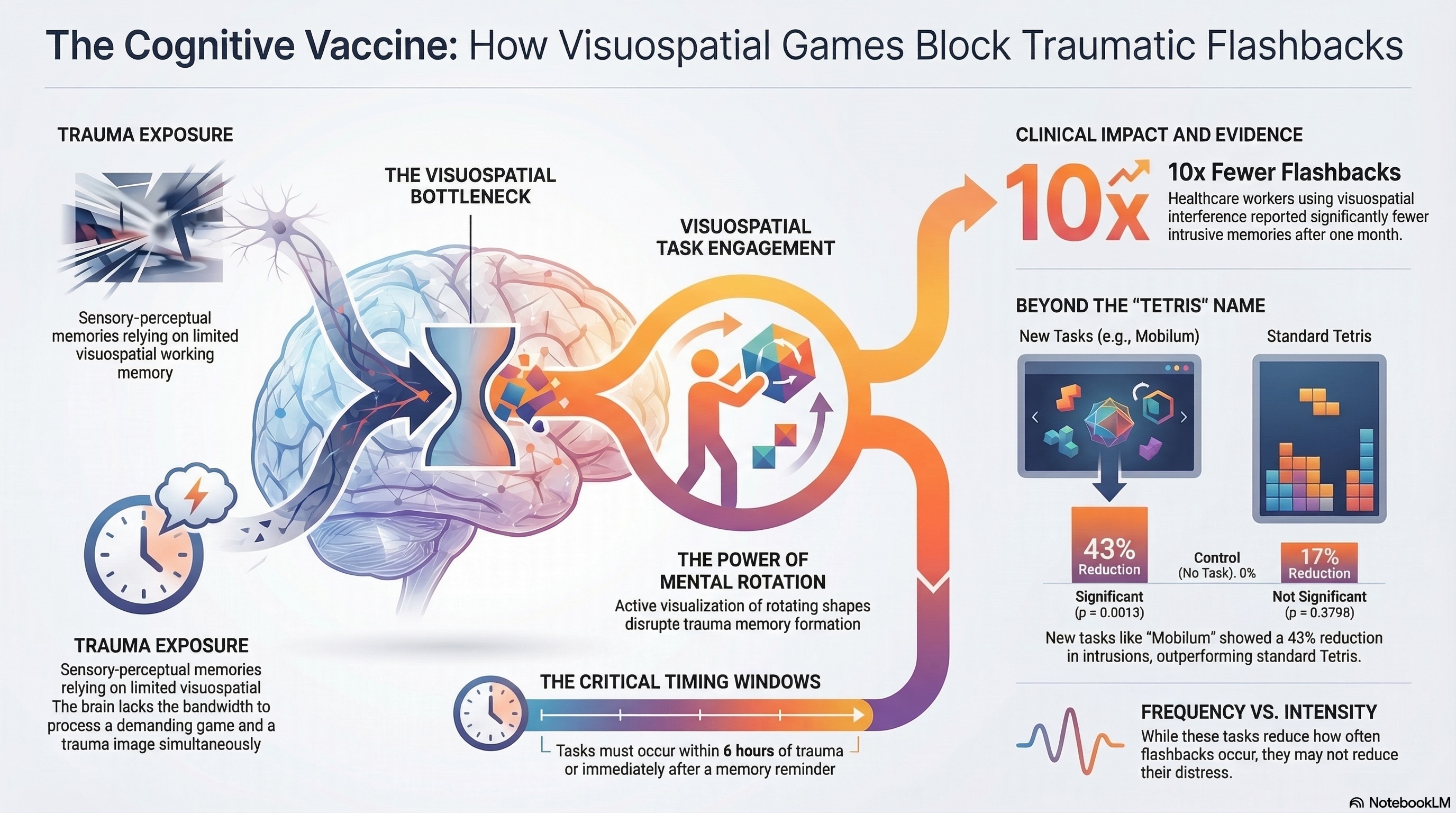
Research shows that playing a visuospatial game like Tetris within six hours of a traumatic event may reduce the frequency of intrusive memories and flashbacks. This works because Tetris uses the same cognitive systems the brain relies on to consolidate traumatic visual memories, creating interference that reduces how vividly those memories are stored. This is known as psychological first aid through dual-task interference, and it is a low-risk, evidence-based option for first aid responders.
After the Emergency Ends: Tetris, Trauma Memory, and Psychological First Aid
First aid does not stop when the physical emergency is resolved. Here is what happens in the hours after a traumatic incident, and what responders can do about it.
First aid training prepares you to respond in the moments of an emergency.
But what happens in the hours and days after an incident can be just as important for the people involved.
Increasingly, first aid responders and workplace safety officers are being asked to understand this, and a growing body of research is giving them something genuinely useful to work with.
Simple psychological interventions in the immediate aftermath of trauma can significantly reduce the risk of long-term distress. One of the most studied involves playing Tetris. This article explains the science, what it means for first aid responders, and when to refer someone for professional support.
What you will learn in this article:
✓ How traumatic memories form in the brain and why some become intrusive
✓ What the dual-task interference model is and why Tetris specifically works
✓ What clinical research has actually found
✓ What first aid responders can practically do in the aftermath of an incident
✓ When and how to refer someone for professional mental health support
1 How Traumatic Memories Form
After a traumatic event, the brain attempts to process and store what happened. Under normal circumstances, memories are organised and accessible without causing excessive distress. After trauma, that process can become disrupted.
Traumatic memories tend to be stored with intense sensory detail, particularly visual information. These vivid fragments can re-emerge later as intrusive images or flashbacks that are difficult to control and deeply distressing.
The critical six-hour window.
Research has identified a window of approximately six hours after a traumatic event during which the memory is still being consolidated. Intervening during this window may influence how strongly the traumatic memory is formed.
This is not about telling someone to forget what happened or minimising their experience. It is about understanding that the brain has a brief period of plasticity after trauma where targeted intervention may reduce the intensity of how those memories are stored.
2 The Dual-Task Interference Model
The research into Tetris and trauma is grounded in the dual-task interference model. This model explains that the brain has limited cognitive resources and that demanding tasks compete for those resources.
Traumatic Memories Use
Visual and spatial processing systems in the brain, storing shapes, movement, and sensory fragments with high intensity.
Tetris Also Uses
The same visuospatial systems, requiring the player to mentally rotate and place shapes in real time. This is not passive viewing. It is active processing.
When a person engages in a task that heavily uses those same visuospatial systems, there is less cognitive capacity available to store and consolidate the traumatic images.
This is not the same as distraction.
Distraction simply takes attention elsewhere. Tetris works because it creates specific interference between two tasks that rely on the same processing systems. Other activities, such as word games or talking, do not produce the same effect because they use different cognitive pathways.
3 What the Research Shows
Several clinical studies have examined the use of visuospatial tasks in the hours following trauma. Trials involving healthcare workers, accident survivors, and people exposed to distressing emergency footage have produced consistent findings.
| Research Finding | What It Means in Practice |
|---|---|
| Reduced frequency of intrusive memories | Participants reported fewer flashbacks and intrusive images in the days and weeks following the intervention. |
| Timing matters significantly | The effect appears greatest when the task is performed within the first six hours of the traumatic event. |
| A second opportunity may exist | More recent research suggests that recalling a traumatic memory reopens a reconsolidation window, which may offer another chance for intervention. |
| Active play is key | Mentally rotating and placing shapes appears more effective than passively watching the game. The cognitive effort is what creates the interference. |
An important limitation to understand:
This approach appears most effective at reducing the frequency of intrusive images rather than changing how distressing those images feel when they do occur. The research is promising but ongoing. It is a low-risk, low-cost option, not a replacement for professional support.
4 What This Means for First Aid Responders
As a first aid responder or workplace safety officer, you are likely to be present in the immediate aftermath of traumatic incidents. Understanding the basics of psychological first aid can help you support colleagues and bystanders in ways that go beyond physical care.
Current guidance from psychological first aid frameworks focuses on four core principles:
| Principle | What It Looks Like |
|---|---|
| Help the person feel safe | Move them away from the scene where possible. Use calm, clear communication. Avoid crowds gathering around them. |
| Reduce ongoing stressors | Limit re-exposure to the incident. Manage bystanders. Reduce noise and chaos in the immediate environment. |
| Connect with support | Help the person contact family, friends, or workplace support. Provide details for professional services if needed. |
| Avoid pressuring them to talk | Do not push the person to recount the event in detail immediately after it occurs. This can interfere with natural processing and may increase distress. |
Where Tetris fits in.
The evidence around visuospatial tasks is not yet reflected in formal psychological first aid guidelines. But it represents a low-risk, low-cost option that trained responders can offer when appropriate, once the person is physically safe and the immediate emergency is managed. Offer it as an option, not an instruction.
Understanding how communication styles change under stress is also valuable context for first aid responders dealing with people in acute distress.
5 When to Seek Professional Support
Not everyone who experiences a traumatic event will develop ongoing difficulties. Many people recover naturally with the support of family, friends, and time. But some will benefit from professional psychological support, and knowing the difference matters.
Signs that professional support may be needed:
✓ Persistent intrusive memories or flashbacks
✓ Active avoidance of reminders of the event
✓ Difficulty sleeping or concentrating
✓ Significant irritability or emotional distress lasting more than a few weeks
✓ Withdrawal from normal activities and relationships
First aid responders are not mental health professionals. But knowing what to watch for, and when to encourage someone to seek help, is a valuable part of a comprehensive response. Your role is to recognise the signs, not diagnose or treat them.
This is especially relevant in workplace contexts. If you are managing first aid responsibilities in a business or workplace setting, understanding the psychological component of incident response helps you support your team more effectively after something serious occurs.
6 First Aid Training That Addresses Mental Health
Modern first aid training increasingly acknowledges the psychological aspects of emergency response, both for casualties and for responders themselves.
Understanding that your role does not end when the physical emergency is resolved is part of becoming a well-rounded, confident first aider. The person who has just witnessed or experienced something traumatic needs support that goes beyond wound dressing and CPR.
Core Training
Nationally recognised first aid certification covering emergency response, including support in the aftermath of critical incidents.
Remote Areas
HLTAID013 Remote and Isolated First Aid
Extended training for those working in regional, remote, or isolated environments where help may be hours away.
Education & Childcare
For educators and childcare workers who may need to manage psychological as well as physical responses to incidents involving children.
You can explore all available training options and book a course through our courses page, or visit the Knowledge Hub for more evidence-based first aid resources.
Frequently Asked Questions
First Aid That Builds Real Confidence
I do not teach First Aid from a checklist. I teach it so that people walk out knowing what to do, and why, when something real happens.
That includes knowing what their role is once the physical emergency is stabilised. The person in front of you may be physically fine but processing something difficult. Understanding that is part of being a confident, capable first aider.
The science around Tetris and trauma is a good example of how evidence keeps evolving in this space. It is worth knowing about, even if it is not yet embedded in formal guidelines. Low-risk, low-cost, and grounded in real research.
The Question Worth Sitting With
If someone near you experienced a traumatic incident today, would you know what to do once the physical emergency was under control? Would you know what to say, what not to say, and when to encourage them to seek professional help? Training builds that confidence before you need it.
Training and Assessment is delivered by Britt at Regional Education and Career Help Australia on behalf of ABC First Aid RTO 3399.
Book Your First Aid Certification in Western Australia
Face-to-face, nationally recognised training delivered across Perth, Rockingham, Mandurah, Byford, Kwinana, Albany, the Wheatbelt, and regional and remote Western Australia. Small groups, practical skills, real-world scenarios.
HLTAID011 Provide First Aid | HLTAID012 Childcare First Aid | HLTAID013 Remote and Isolated First Aid | HLTAID014 Advanced First Aid
View All First Aid Courses