Tetris and Trauma Recovery: The Brain's Hidden Reset
Mental Health First Aid: A Simple Tool That Can Reduce Trauma Flashbacks
What helps reduce trauma flashbacks after an incident?
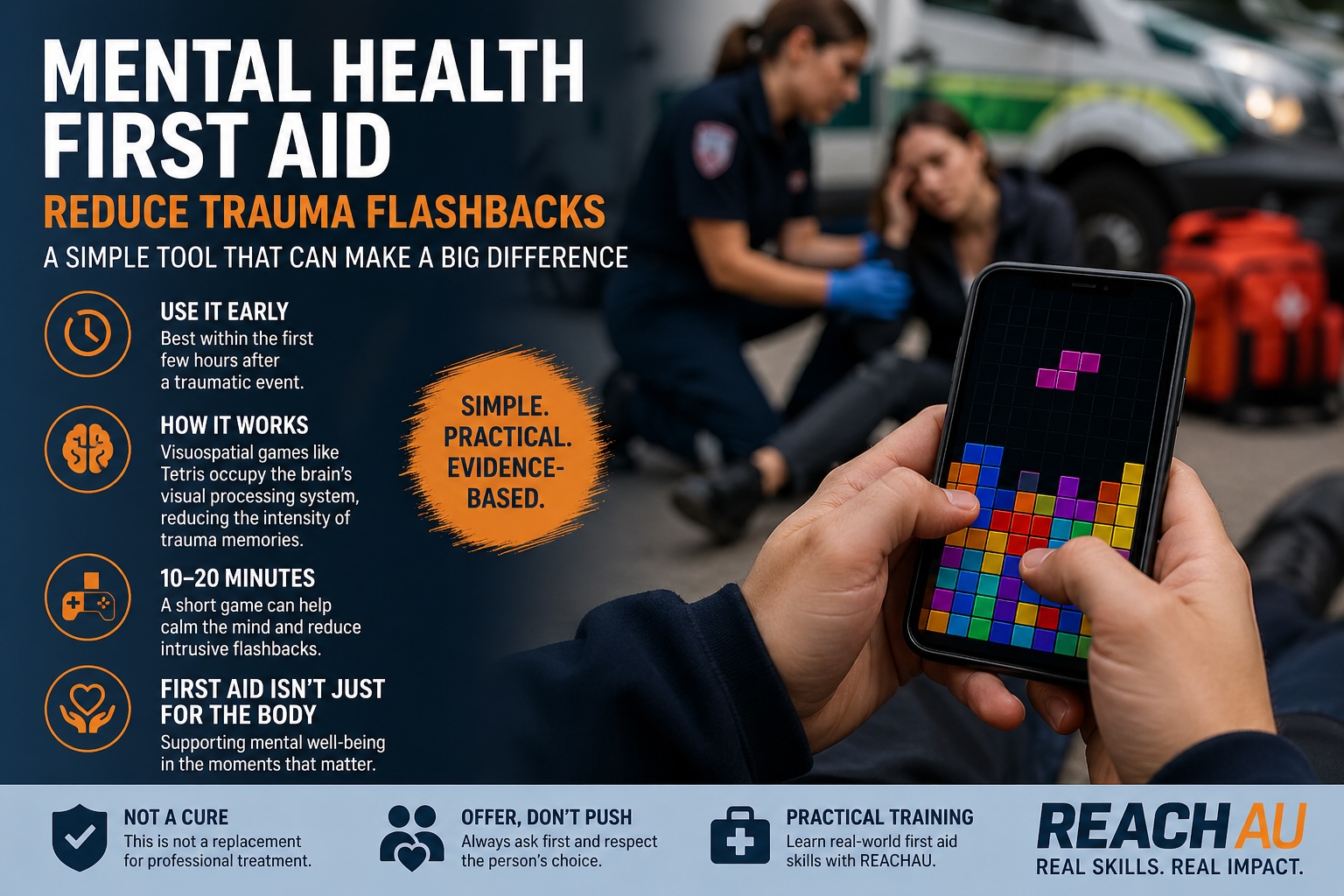
Playing a visuospatial game like Tetris within the first few hours after a traumatic event can reduce the intensity and frequency of flashbacks by interrupting how the brain stores visual memories.
Real-world support for people across Perth and regional WA
When people think about first aid, they think CPR, bleeding control, or splints.
That matters. It always comes first.
But there is another piece most people miss.
What happens in the hours after a traumatic event can shape how someone processes it long-term.
And one of the simplest tools available is something most people already have in their pocket.
The Tetris Approach to Mental Health First Aid
This is not a trend or a gimmick.
There is real research showing that simple visual tasks like playingTetriscan reduce the intensity and frequency of trauma flashbacks.
It works best when used shortly after an incident.
Think of it as early intervention for the brain.
Not a replacement for therapy.
Not a cure.
But a practical step that can reduce how hard the memory hits later.
What Is Actually Happening in the Brain
After a traumatic event, the brain is trying to store what just happened.
If that process doesn’t go smoothly, the memory can come back as intrusive, looping images.
That is what people experience as flashbacks.
Your brain has limited capacity to process visual information.
When someone plays a game like Tetris, it uses that same visual processing system.
So instead of the brain locking in distressing imagery, it is busy doing something else.
End result:
The memory is still there
But the intensity is reduced
The “replay effect” is less likely
Simple. Practical. Useful.
What the Evidence Shows
This isn’t theory sitting on a shelf.
It has been tested in real settings:
Emergency departments
People involved in accidents reported significantly fewer flashbacks in the following weekHealthcare workers during COVID
Flashbacks dropped from multiple per week to minimalTrauma therapy settings
Used alongside treatment, it supported measurable improvements
This is why it is worth knowing.
How to Use This in a Real Situation
If you are supporting someone after an incident, this is how it fits in.
1. Deal with physical first aid first
Always. No exceptions.
2. Use it early
Best window is within the first few hours, but it can still help later when the memory is fresh.
3. Keep it short
10 to 20 minutes is enough.
4. Offer, don’t push
This is a tool, not a directive.
You can frame it like this:
“Sometimes doing something simple like a puzzle game can help your brain settle after something like this. Want to give it a go?”
What This Is Not
Let’s be clear.
This is not a replacement for counselling
This is not a treatment for PTSD
This is not a standalone solution
It isfirst aid for the brain, in the same way a bandage is first aid for a wound.
It helps early. It doesn’t finish the job.
Common Questions
Does any game work?
No.
It needs to be visual and pattern-based.
Games like Tetris or Candy Crush work because they use visual processing.
Scrolling social media or reading text does not do the same thing.
Can this prevent PTSD?
It can reduce one of the key symptoms, which is intrusive flashbacks.
That matters.
But ongoing support may still be needed depending on the situation.
Where does this fit into training?
Right now, most first aid training does not cover this.
That is changing.
Because real-world response is not just physical anymore.
The Real Takeaway
First aid is not just about keeping someone alive.
It is about what happens next.
If you can reduce the mental impact of a traumatic event in the first few hours, you are changing that person’s recovery path.
That is powerful.
And it is simple.
Want Training That Covers Real Situations?
Most courses will teach you the basics.
That is not enough in real life.
At REACHAU, training is built around what actually happens in emergencies.
Physical response. Decision-making under pressure. And what to do after the incident.