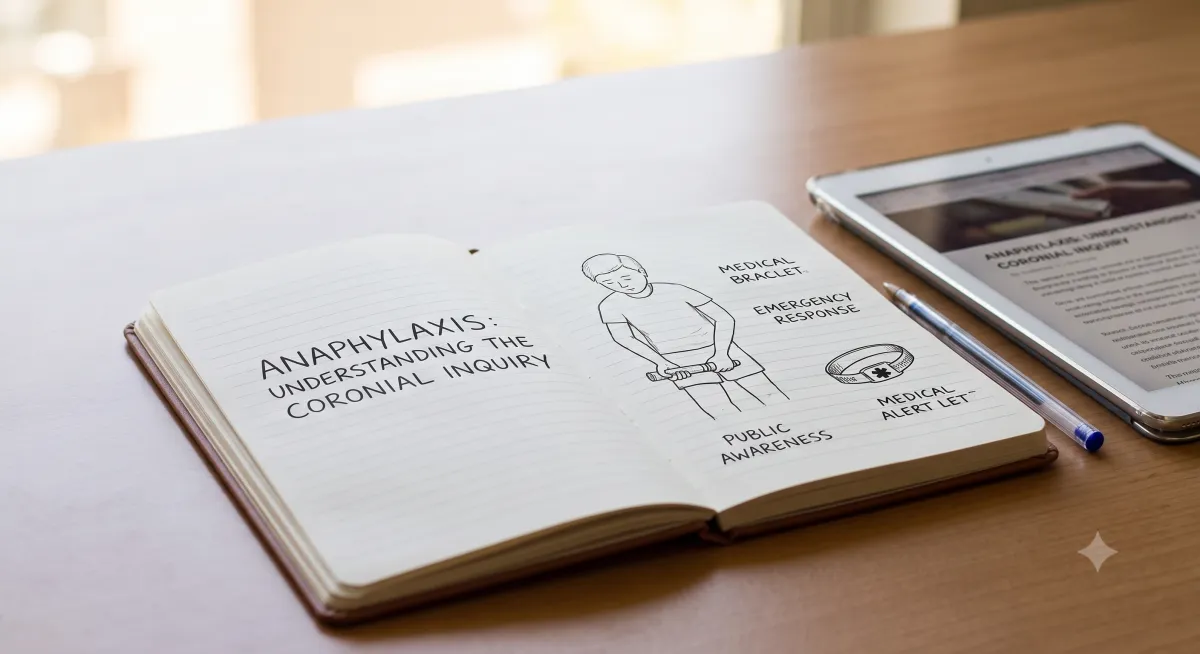
Anaphylaxis or Asthma? Lessons from Max McKenzie's Inquest
When Anaphylaxis Looks Like Asthma: What We Must Learn from Max McKenzie's Story
What Australian families, educators, workplaces and first aiders need to understand
First Aid Basics | Emergency First Aid Scenarios | Anaphylaxis and Asthma
August 2026 | Anaphylaxis & Allergy
Content note: This article discusses the death of a 15-year-old following a severe anaphylactic reaction. It has been written with respect for Max, his family and the clinicians involved.
When we teach anaphylaxis, it is easy to make it sound straightforward.
Recognise the signs. Give adrenaline. Call 000. Follow the action plan.
Those steps are correct, and they need to remain simple enough for an ordinary person to remember under pressure. But the reason behind them matters. Anaphylaxis can move quickly. It does not always arrive with the obvious signs people expect. When asthma and food allergy exist together, sudden breathing difficulty can be mistaken for asthma when it may actually be anaphylaxis.
That distinction matters because the first treatment is different.
The amended coronial finding into the death of 15-year-old Max Peter McKenzie was published in February 2026. It is a difficult document to read. It describes a young person who was intelligent, energetic and deeply loved. It also describes an exceptionally severe allergic reaction, a rapidly changing emergency and the efforts of Max, his family, paramedics and hospital clinicians to save him.
This article is not an attempt to retry the inquest, blame individual clinicians or reduce an extraordinarily complex medical emergency to a social media slogan. The coroner expressly noted that a coronial investigation is not about deciding civil or criminal liability or assigning blame. The coroner also found that the clinicians caring for Max did their very best in rare and incredibly challenging circumstances.
The purpose here is different. It is to ask what parents, teachers, childcare educators, coaches, employers and first aiders can learn. It is to explain why the first few actions in an anaphylaxis emergency matter. Most importantly, it is to help people build an automatic response that still works when the situation is frightening, confusing or does not look exactly like the examples in a training manual.
Allergy & Anaphylaxis Awareness
Help raise awareness and support anaphylaxis research in Australia.
Every dollar raised supports research, education and resources that improve outcomes for people living with serious allergies. Please consider contributing.
What This Article Covers
▶ Who Max McKenzie was and what the coronial findings mean
▶ Why anaphylaxis can look exactly like asthma
▶ Why a rash is not required for anaphylaxis to be happening
▶ The first aid sequence that needs to become automatic
▶ What schools, workplaces and families should check right now
▶ Why practical, scenario-based training changes outcomes
1. First, Max Was a Person, Not a Case Study
Max was born on 7 January 2006. The coroner described him as a high school student with a talent for debating, performing and kayaking. He was remembered for his kindness, curiosity and energy. He loved his family and embraced life.
He was also a son, brother, grandson, friend and classmate.
That should remain at the centre of any discussion about this inquest. Coronial findings contain times, drug doses, clinical observations and expert opinions because the court must establish what happened and identify opportunities to prevent future deaths. Behind every paragraph is a family living with an unimaginable loss.
Max's father, Dr Ben McKenzie, has undertaken extensive advocacy and education about anaphylaxis. The coroner acknowledged that this work, supported by Max's mother Tamara and their family, has contributed significantly to clinical reflection and community learning.
We should learn from Max's story without treating it as dramatic content. We should not use hindsight to imply that every severe allergic reaction will follow the same path. We should also not allow the rarity and complexity of what happened to make us look away from the simple first aid lessons that can help in a more typical emergency.
2. What Happened on 6 August 2021
Max had asthma and was allergic to tree nuts and peanuts. He had been prescribed an EpiPen when his food allergies were diagnosed as a toddler.
At about 1:00 pm on 6 August 2021, Max ate apple crumble at his grandmother's house. Neither Max nor his grandmother knew it contained nuts. He began to experience an allergic reaction.
At approximately 1:25 pm, his grandmother called his mother. When Tamara arrived, Max was alert. He said he felt sick in the stomach and felt as though he needed Ventolin.
At about 1:40 pm, Max used his EpiPen and Ventolin. Emergency services were called at around 1:50 pm. An Ambulance Victoria crew arrived at 1:57 pm.
Initially, Max did not appear profoundly unwell, although his work of breathing had increased. He reported chest tightness soon after eating the crumble and tightness in his abdomen. Importantly, Max told the paramedics that he believed he was experiencing anaphylaxis rather than asthma.
His condition then deteriorated dramatically.
The paramedics called for MICA backup, administered intramuscular adrenaline and provided other treatment. Max's breathing became increasingly difficult. His oxygen level fell. He became distressed and later had a seizure, became unconscious and stopped breathing. Ventilating him with a bag-valve mask was difficult because of severe resistance.
He was transported to Box Hill Hospital, only a short drive away, in a critically unwell condition. At hospital, a large clinical team continued resuscitation. Attempts to place a breathing tube through his mouth were unsuccessful in the presence of profound breathing difficulty and vomiting. An emergency surgical airway was established through his neck. His circulation returned, and extracorporeal membrane oxygenation, known as ECMO, was commenced.
Max survived the initial event, but he had sustained a severe brain injury caused by lack of oxygen. He died at the Royal Children's Hospital on 19 August 2021.
The coroner determined the cause of death to be cardiorespiratory arrest of unknown cause complicating hypoxic ischaemic encephalopathy in the setting of anaphylaxis.
That wording is clinical. In plain English, Max suffered a severe anaphylactic event, his body and brain were deprived of oxygen, and he later experienced a fatal cardiorespiratory arrest.
3. This Was an Exceptionally Severe and Rare Reaction
It is important not to read this chronology and assume that adrenaline devices usually fail or that anaphylaxis is normally impossible to manage.
The evidence described Max's condition as refractory anaphylaxis. Refractory means that the reaction did not respond as expected to the initial treatment. One expert told the inquest that fewer than 2 per cent of people experiencing anaphylaxis fail to respond to one or two doses of adrenaline. Max was in that very small group.
The experts described an extreme, rapidly progressive episode of anaphylaxis that primarily appeared as life-threatening bronchospasm. Bronchospasm means the muscles surrounding the airways tighten, narrowing the tubes through which air must move. In Max's case, this narrowing became so severe that moving air into his lungs was extraordinarily difficult.
That does not make adrenaline the wrong treatment. It confirms why adrenaline must be given early. Most anaphylaxis responds to prompt first-line treatment. A reaction at the extreme end of severity may continue despite appropriate action, but that is not a reason to delay the action that offers the best chance of stopping it.
Australian guidance is direct: adrenaline is the first-line treatment for anaphylaxis. If there is no response after five minutes, another dose may be required when another device is available. If in doubt, it is better to give adrenaline than to withhold it.
First aid cannot guarantee an outcome. Nothing in first aid can. What it can do is give a person their best available chance while more advanced help is coming.
4. Why Anaphylaxis Can Look Like Asthma
Asthma and anaphylaxis can share signs. Both can cause:
▸ Difficulty breathing
▸ Wheeze
▸ Persistent cough
▸ Chest tightness
▸ Anxiety or distress
▸ Difficulty speaking normally
That overlap can create hesitation. A person with asthma feels short of breath, so the familiar asthma puffer seems like the obvious first step. In an ordinary asthma attack, it may be. But if the person also has a known allergy and may have been exposed to the allergen, sudden breathing difficulty must raise the possibility of anaphylaxis.
The 2026 ASCIA Action Plan states that when someone with known asthma and allergy to food, insects or medication has sudden breathing difficulty after possible allergen exposure, the adrenaline device should always be given first, followed by the asthma reliever puffer.
Why? Because an asthma reliever acts mainly on tightened airway muscles. It can help open the lower airways in asthma and may be used after adrenaline when breathing symptoms are present. It does not reverse the whole-body allergic reaction of anaphylaxis.
Anaphylaxis can involve several dangerous processes at once:
▸ The airway can swell
▸ The muscles around the lower airways can tighten
▸ Blood vessels can widen and leak fluid, causing blood pressure to fall
▸ The circulation can become inadequate
▸ Oxygen delivery to the brain and other organs can fail
Adrenaline acts across these life-threatening problems. It helps reduce airway swelling, supports the circulation and relaxes tightened airway muscles. That is why it comes first when anaphylaxis is suspected.
The reliever puffer still has a role where asthma symptoms are present. It follows adrenaline. It does not replace it.
5. No Rash Does Not Mean No Anaphylaxis
One of the most dangerous myths about anaphylaxis is that there must be hives, a rash or facial swelling.
There may be skin signs, but they are not required.
The ASCIA plan specifically warns that anaphylaxis can occur without skin symptoms. A person may have difficult or noisy breathing, swelling of the tongue, tightness in the throat, trouble talking, wheeze, persistent cough, dizziness or collapse without a visible rash.
After food exposure, sudden breathing difficulty in a person with asthma and a known food allergy must not be dismissed because their skin looks normal.
This is where understanding the why becomes protective. If someone has memorised only a picture of a swollen face, they may wait for that picture to appear. If they understand that anaphylaxis is a rapidly developing systemic reaction, they are more likely to recognise the emergency from the breathing, circulation or gastrointestinal signs in front of them.
6. Abdominal Symptoms Can Be Part of the Warning
The inquest recorded that Max felt sick in the stomach and described abdominal tightness. These details matter because people often separate stomach symptoms from an allergic emergency.
After exposure to a likely allergen, abdominal pain or vomiting can be part of an allergic reaction. ASCIA guidance distinguishes between signs of a mild to moderate allergic reaction and signs of anaphylaxis, but context is essential. Gastrointestinal symptoms alongside sudden breathing difficulty, throat symptoms, dizziness or collapse should increase concern, not reassure us.
The correct response does not depend on a first aider diagnosing the exact biological pathway. We are not expected to decide whether each symptom comes from asthma, anxiety, allergy or a combination. We are expected to recognise a credible anaphylaxis emergency and take the first correct action.
7. Anxiety Can Be a Consequence of Not Getting Enough Air
Max became increasingly anxious and distressed as his breathing deteriorated. At one point, he expressed fear that he would die.
People in severe respiratory distress may appear panicked, agitated or uncooperative. That behaviour can be misread as the cause of their breathing problem. Sometimes anxiety does make breathing feel harder. However, in a person with objective signs of respiratory compromise, agitation may be a sign that the brain is not receiving enough oxygen, that carbon dioxide is building up, or simply that the person understands how serious the situation has become.
Do not let the word "anxiety" reduce the urgency of physical danger.
Look at the whole person. Are they working hard to breathe? Can they speak normally? Are they becoming pale, blue, confused, drowsy or exhausted? Has there been possible allergen exposure? Is their condition getting worse despite their usual asthma treatment?
Reassure them, but do not reassure yourself into waiting.
8. What Adrenaline Actually Does
Many people hesitate to use an adrenaline device because they are afraid of the medicine. They worry about a racing heart, shaking or the possibility that they have misread the symptoms.
This fear is understandable, but it puts the risk in the wrong order.
During anaphylaxis, the immediate threat is the reaction. Adrenaline helps counter it in several ways:
✓ It tightens blood vessels, helping support blood pressure and circulation.
✓ It reduces leakage from blood vessels, which helps limit swelling.
✓ It relaxes muscles around the airways, helping air move more freely.
✓ It supports the heart during a rapidly deteriorating emergency.
An adrenaline device delivers a measured dose into the outer mid-thigh. It is designed for emergency use by members of the community. Temporary effects such as a fast heartbeat, trembling, paleness or headache can occur. Those effects are not equivalent to the danger of untreated anaphylaxis.
ASCIA's 2026 advice puts this plainly: under-treatment of anaphylaxis is more harmful and potentially life-threatening than over-treatment of a mild or moderate allergic reaction.
You do not need to wait until the person is unconscious. You do not need every possible sign. You do not need to be completely certain.
If the signs and context indicate anaphylaxis, use the device.
9. The First Aid Response That Needs to Become Automatic
In an emergency, the most important skill is staying calm and taking the first correct action.
For suspected anaphylaxis, follow the person's ASCIA Action Plan if available and use this sequence:
Lay the person flat. Do not allow them to stand or walk. If breathing is difficult, they may sit with their legs outstretched. If unconscious or pregnant, position them as shown on the current ASCIA plan.
Give the adrenaline device into the outer mid-thigh without delay. Follow the instructions for the available device.
Call 000 and ask for an ambulance. Say "anaphylaxis" clearly.
Give a further adrenaline dose after five minutes if there is no response and another device is available.
Give asthma reliever after adrenaline if the person also has asthma and has breathing symptoms.
Monitor breathing and responsiveness continuously. If the person becomes unresponsive and is not breathing normally, begin CPR and use an AED as soon as one is available.
There are two parts of this response that people regularly underestimate: positioning and not allowing the person to walk.
Anaphylaxis can cause a sudden fall in blood pressure. Standing or walking can make the circulation problem worse. That is why the instruction is not simply "help them get comfortable". Keep them in the recommended position and bring the device, phone and help to them.
If they are struggling to breathe, sitting with legs outstretched may be necessary. Do not have them standing, walking around or sitting upright on a chair with their legs hanging down. Follow the action plan for the person's condition.
10. Give Adrenaline First, Then Call 000
People sometimes debate whether the phone call or injection should happen first. In real life, if several people are present, these actions should happen almost together. One person gives adrenaline while another calls 000 and retrieves a second device and the AED.
If you are alone, the current ASCIA sequence places the adrenaline device before the ambulance call. The medicine needs to enter the body. A phone call does not treat the reaction.
Once the device has been given, call immediately. Do not wait to see whether it works before asking for an ambulance. A person who improves can worsen again. They require medical assessment and observation.
Tell the call taker:
▸ That the person is having suspected anaphylaxis
▸ Their age and location
▸ The suspected trigger if known
▸ The signs you can see
▸ When adrenaline was given
▸ How many doses have been given
▸ Whether they have asthma
▸ Whether they are conscious and breathing normally
Put the phone on speaker if practical and follow instructions while continuing care.
11. Why the Five-Minute Check Matters
A first dose of adrenaline is not the end of the response.
Note the time it was given. Watch the person. If there is no response after five minutes and another device is available, current Australian guidance supports giving a second dose.
Five minutes can feel both very long and very short in an emergency. Without someone deliberately watching the time, it can pass unnoticed. Give one person the specific job of timing and announcing the five-minute mark.
This is a useful workplace, school and event-planning lesson. Do not simply say, "Someone call an ambulance." Allocate roles:
✓ You give the adrenaline device.
✓ You call 000 and meet the ambulance.
✓ You bring the second device and action plan.
✓ You bring the AED and first aid kit.
✓ You record times and changes.
✓ You keep other people back and make space.
Clear roles reduce confusion and cognitive overload. The inquest discussed the effect of limited resources, competing treatment priorities and role clarity in advanced care. A first aid team is not an emergency department, but the same human factor applies: when everybody assumes somebody else is doing a task, important actions can be delayed.
12. Do Not Rely on the Person to Manage Alone
Max recognised that he was experiencing anaphylaxis and administered his own EpiPen. His awareness is significant. It also reminds us that a person having the reaction may be making decisions while frightened, breathless and becoming unwell.
Support them immediately.
Do not send them to another room to find their device. Do not tell them to walk to the first aid office. Do not leave them alone while you look for a supervisor. Bring help and equipment to them.
In workplaces and community settings, the emergency plan must work even if the person cannot speak, cannot reach their bag or loses consciousness. Staff need to know where general-use devices are stored, who checks expiry dates, and how to access them without waiting for a keyholder.
For children and teenagers, adults must take sudden symptoms seriously even when the young person is trying to minimise them. Adolescents may not want attention, may be embarrassed to interrupt an activity or may hope symptoms will settle. A culture of "tell us early and you will never be in trouble" is a safety measure.
13. Antihistamines Are Not the First Treatment for Anaphylaxis
Antihistamines may help some skin symptoms in mild allergic reactions. They do not treat the severe breathing or cardiovascular problems of anaphylaxis.
They must not delay adrenaline.
This mistake often comes from familiarity. People have taken antihistamines for hay fever, hives or mild reactions, so the medicine feels safe and appropriate. But anaphylaxis is not simply a bigger rash. It is a potentially life-threatening systemic emergency.
If the person has signs of anaphylaxis, the treatment is adrenaline. Not an antihistamine first. Not a drink of water. Not a shower. Not waiting for a rash. Not driving them to hospital instead of calling an ambulance.
Adrenaline, then 000.
14. Why Severe Asthma and Allergy Need a Joined-Up Plan
The Safer Care Victoria review considered the combination of asthma and anaphylaxis to be a high-risk area requiring clearer, more consistent messaging. It noted that separate guidelines for severe asthma and anaphylaxis could create confusion when a patient presented with both.
The coroner recommended that Ambulance Victoria review its separate asthma and anaphylaxis guidelines to ensure consistency in relation to adrenaline therapy.
For members of the public, the message is already direct: when someone with known asthma and allergy to food, insects or medication has sudden breathing difficulty after possible exposure, give adrenaline first and then the asthma reliever.
For families, schools and workplaces, this should lead to a practical review. Ask:
▸ Does the person have both an Asthma Action Plan and an ASCIA Action Plan for Anaphylaxis where clinically appropriate?
▸ Are the plans current and completed by the relevant treating health professional?
▸ Do the people likely to help understand which treatment comes first when the cause is uncertain?
▸ Are adrenaline devices and asthma relievers immediately accessible?
▸ Is there more than one adrenaline device available?
▸ Do carers and staff know that anaphylaxis may occur without a rash?
▸ Do they know the person must not stand or walk?
▸ Has the response been practised, rather than only read?
Plans should be developed and reviewed with the person's doctor or other qualified health professional. First aid training supports the response to an emergency; it does not replace individual medical management.
15. The Coroner's Findings on Medical Care
The inquest examined whether the care provided by Ambulance Victoria paramedics and Eastern Health clinicians was reasonable and appropriate, and whether prevention opportunities arose.
The expert evidence was not identical. Some experts believed earlier interventions might have changed the outcome. Others considered Max's reaction so severe that a poor outcome may have occurred even with ideal treatment.
The coroner found that Max's deteriorating condition required earlier and more frequent adrenaline while he was being treated by paramedics, consistent with the applicable Ambulance Victoria guideline. At the same time, the coroner recognised that paramedics were managing a rapidly evolving and distressing situation with limited resources and competing priorities. The coroner was satisfied that there was no unreasonable delay at the scene and found that the decision to prioritise transport rather than attempt a high-risk intubation before the short journey to hospital was reasonable.
At Box Hill Hospital, the first attempt to intubate Max occurred about 15 minutes after arrival. The coroner found that reasonable care required an earlier attempt to establish a secure airway. Max was critically hypoxic, and a mechanical airway offered his best opportunity for survival.
However, the coroner did not find that Max's death was proven preventable. The finding was more careful than that. Earlier adrenaline and earlier establishment of a secure airway would have given Max the best opportunity for survival, but his refractory anaphylaxis was exceptionally severe. Even with earlier action, he may still have suffered cardiac arrest, brain injury or death.
That distinction matters.
We can identify opportunities for better care without pretending certainty about an outcome that cannot be known. We can respect the work of clinicians while still learning from delay, communication difficulty and system limitations. We can acknowledge that people did their best and also improve what happens next time.
16. The Coroner's Recommendations
The coroner made two formal recommendations:
✓ Ambulance Victoria should review its separate guidelines for treating asthma and anaphylaxis to ensure consistency concerning adrenaline therapy.
✓ Ambulance Victoria should ensure graduate paramedics receive emergency-driving training during induction before beginning on-road clinical practice.
The second recommendation arose from a practical staffing problem during Max's transport. The graduate paramedic was not qualified to drive under emergency conditions. This meant the more experienced clinical instructor drove, rather than both senior clinicians being available in the back of the ambulance. The coroner considered that earlier emergency-driving training could provide greater flexibility in future critical cases.
The inquest also referred to the broader recommendations already made through the Safer Care Victoria review. These included escalation processes, critically unwell paediatric education, multidisciplinary simulation, clearer leadership and roles during resuscitation, improved handover and notification, and better alignment of guidance for patients with both asthma and anaphylaxis.
These are health-system matters, but they offer lessons for every organisation responsible for emergency planning: equipment matters, training matters, communication matters and a plan must work under real pressure, not only on paper.
17. What Schools and Childcare Services Should Check
Schools and childcare services often have strong allergy policies, but compliance documents are not the same as readiness.
Check the real pathway from first symptom to treatment:
▸ Can every relevant staff member recognise anaphylaxis without skin symptoms?
▸ Can relief, administration, grounds and casual staff locate the devices immediately?
▸ Are devices taken to the oval, playground, excursion, bus, camp and sporting event?
▸ Can a staff member use each type of device kept onsite?
▸ Is there a current individual action plan available without searching through a locked office?
▸ Is a general-use adrenaline device available in addition to prescribed devices, in line with organisational requirements and risk assessment?
▸ Does someone check expiry dates and device condition?
▸ Are emergency contacts current?
▸ Is the ambulance access point obvious and unlocked?
▸ Can staff explain that adrenaline comes before the asthma reliever when anaphylaxis is suspected?
A child should never have to walk to the sick bay during suspected anaphylaxis. Treatment must come to the child.
Practice scenarios should include ambiguity. Do not train only the obvious version with hives, facial swelling and a child conveniently holding an EpiPen. Run a scenario involving sudden cough and wheeze after food exposure, no rash, a device inside a backpack, a locked gate and a second dose that may be needed.
That is where gaps become visible.
18. What Workplaces, Clubs and Event Organisers Should Check
Anaphylaxis is not only a school issue. Adults may experience reactions at workplaces, restaurants, sporting clubs, community events, remote sites and during travel.
Workplaces should know:
▸ Where adrenaline devices are located
▸ Whether a general-use device is appropriate for the site's risk profile
▸ Who is trained to use the devices onsite
▸ How 000 will be contacted when reception is poor
▸ Who will meet and direct the ambulance
▸ How responders will access remote or restricted areas
▸ Where the AED is located
▸ How incident details and treatment times will be recorded
Food service deserves particular attention. Ingredient knowledge, cross-contact controls and clear communication are essential, but mistakes can still occur. Emergency readiness is the final protective layer when prevention has failed.
For regional and remote workplaces, response time changes the planning. That does not mean improvising medical treatment. It means speaking with appropriate health professionals, carrying suitable equipment, ensuring communication coverage, training enough people across every shift and having a clear emergency access and evacuation plan.
19. What People at Risk and Their Families Can Do
Responsibility for anaphylaxis should never be placed entirely on the person at risk, especially a child or teenager. Still, preparation can make it easier for others to help.
Consider the following with the person's treating health professional:
✓ Keep the ASCIA Action Plan current.
✓ Carry the prescribed adrenaline device and know how to use it.
✓ Carry more than one device where advised.
✓ Check expiry dates and the viewing window, where applicable.
✓ Store devices away from excessive heat or cold, following manufacturer advice.
✓ Make sure family, friends, colleagues, teachers and coaches know where the device is.
✓ Explain that sudden breathing symptoms after possible allergen exposure mean adrenaline first when anaphylaxis is suspected.
✓ Practise saying, "This is anaphylaxis. Give my adrenaline now."
✓ Wear medical identification if appropriate.
✓ Review asthma control with the treating health professional.
Do not assume that owning a device equals being ready. In an emergency, people may freeze, forget which end goes against the leg or wait for permission. Regular practice with trainer devices helps turn knowledge into action.
20. What Good First Aid Training Should Change
A first aid course should not leave people able to pass a quiz but afraid to touch the device.
People need to understand:
▸ Why adrenaline is first-line treatment
▸ Why asthma reliever medication is not a substitute
▸ Why a rash is not required
▸ Why the person should not stand or walk
▸ Why a second dose may be needed after five minutes
▸ Why 000 must be called even if the person improves
▸ Why CPR begins if the person becomes unresponsive and is not breathing normally
Then they need to practise.
They should hold trainer devices, work through different brands where possible, make a mock 000 call, allocate roles and respond to a scenario that changes. They should experience the moment where the first dose has been given and nothing appears to improve, because that is when a calm five-minute reassessment matters.
This is what I mean by teaching for autopilot.
Autopilot is not mindless action. It is a well-understood sequence practised enough that stress does not erase it. The learner understands the reason for each step, so when the emergency looks slightly different from the classroom example, they can still make the right decision.
21. A Simple Scenario to Test Your Response
Imagine this.
A 16-year-old with known asthma and cashew allergy eats a dessert at a community event. Ten minutes later, they begin coughing and say their chest feels tight. There is no rash. They use their reliever puffer, but their breathing becomes more difficult. They look frightened and say they feel sick.
What should happen?
Do not wait for facial swelling. Do not decide it is "just asthma" because they are wheezing. Possible allergen exposure, known allergy and sudden breathing difficulty point to anaphylaxis.
Lay them flat, or allow them to sit with legs outstretched if breathing is difficult. Give the adrenaline device first. Call 000. Give the asthma reliever after adrenaline. Note the time. Prepare the second device. If symptoms have not responded after five minutes, give the second dose. If they become unresponsive and are not breathing normally, begin CPR and use an AED.
That sequence should be available in your mind before you need it.
Frequently Asked Questions
Can anaphylaxis happen without hives or swelling?
Yes. Anaphylaxis can occur without skin symptoms. Sudden difficult or noisy breathing, tongue or throat swelling, wheeze, persistent cough, voice change, dizziness or collapse can indicate anaphylaxis. Consider the circumstances, including known allergy and possible exposure.
If the person has asthma and allergy, which medication comes first?
If someone with known asthma and allergy to food, insects or medication has sudden breathing difficulty after possible allergen exposure, current ASCIA guidance says to give the adrenaline device first, then the asthma reliever puffer.
What if I am not sure whether it is asthma or anaphylaxis?
When anaphylaxis is a credible possibility, give adrenaline first. Australian guidance emphasises that the harm of failing to treat anaphylaxis outweighs the risk of unnecessary adrenaline from an autoinjector.
Should I give an antihistamine first?
No. Antihistamines do not treat the dangerous breathing and circulation problems of anaphylaxis. They must not delay adrenaline.
Should the person walk to the ambulance or first aid room?
No. Do not allow a person with anaphylaxis to stand or walk. Keep them flat, or sitting with legs outstretched if breathing is difficult, and bring treatment and help to them.
What if the first adrenaline dose does not work?
Call 000, continue monitoring and give another dose after five minutes if there is no response and another device is available. Follow the person's ASCIA Action Plan and the ambulance call taker's instructions.
Do I still call 000 if the person feels better?
Yes. Anaphylaxis is a medical emergency. Symptoms can return, and the person needs medical assessment and observation.
When do I start CPR?
Start CPR if the person becomes unresponsive and is not breathing normally. Send for an AED and attach it as soon as possible. Continue until the person responds, qualified help takes over or you cannot continue.
Did the coroner find that Max's death was preventable?
No. The coroner found that earlier and more adrenaline during ambulance care and earlier establishment of a secure airway at hospital would have given Max the best opportunity for survival. However, because his refractory anaphylaxis was exceptionally severe, the coroner was not comfortably satisfied that his death was preventable.
22. The Lesson Is Not Fear. It Is Readiness.
Max's story is confronting because he had a known allergy, recognised the reaction and used his EpiPen, yet the reaction continued to progress. It shows that rare, extreme anaphylaxis exists and that even skilled teams can face an extraordinarily difficult emergency.
But fear is not the useful takeaway.
The useful takeaway is that anaphylaxis deserves decisive early action. Breathing symptoms may be anaphylaxis even without a rash. In someone with asthma and relevant allergy, adrenaline comes before the asthma reliever when anaphylaxis is suspected. The person should not stand or walk. A second dose may be needed after five minutes. 000 must be called. CPR starts if the person becomes unresponsive and is not breathing normally.
These are learnable actions.
We cannot promise that every emergency will end well. We can make sure hesitation, confusion and lack of practice do not take away the best chance available.
That is why first aid training needs to go beyond ticking a box. People should leave understanding what is happening inside the body, why the treatment works and what they need to do first. Confidence does not come from pretending emergencies are simple. It comes from making the correct response clear enough to use when the situation is not.
Max's family has worked to ensure that people continue to learn from him. The most respectful response is to turn that learning into action.
Review the plans. Check the devices. Practise the sequence. Teach the reason. If anaphylaxis happens, give adrenaline and call 000.
Sources and Further Information
Coroners Court of Victoria, Inquest into the Death of Max Peter McKenzie, Finding into Death Following Inquest, delivered 5 February 2026 and amended 20 February 2026.
ASCIA First Aid Plan for Anaphylaxis
ASCIA Action Plans for Anaphylaxis
ANZCOR Guideline 9.2.7: First Aid Management of Anaphylaxis
ANZCOR Guideline 9.2.5: First Aid for Asthma
Healthdirect: Anaphylaxis
Important: This article provides general first aid education and is not individual medical advice. People at risk of anaphylaxis or asthma should follow their personal action plans and seek advice from their treating health professional.
Support Anaphylaxis Research
I am helping raise funds for anaphylaxis research initiatives.
If you would like to contribute or learn more, you can visit the fundraising page and make a donation in support of anaphylaxis research across Australia.
Build the Skills to Act When It Counts
Anaphylaxis emergencies can move fast. The right training helps you recognise the signs, understand the correct response, and act with confidence before paramedics arrive.
REACHAU delivers practical, empowerment-focused First Aid training across Western Australia, including group and workplace bookings.
HLTAID009 CPR | HLTAID011 Provide First Aid | HLTAID012 Education and Care | HLTAID013 Remote First Aid | HLTAID014 Advanced First Aid
View Upcoming First Aid Courses
Training and assessment is delivered by Britt at Regional Education and Career Help Australia on behalf of ABC First Aid RTO 3399.
Tags: Max McKenzie, anaphylaxis and asthma, adrenaline first anaphylaxis, anaphylaxis without rash, ASCIA action plan, EpiPen, anaphylaxis first aid, coronial findings, school anaphylaxis, workplace anaphylaxis training
Britt Brennan
Britt Brennan is on a mission to redefine First Aid training through the lens of empowerment and "quiet capability." As the founder of REACHAU, she leverages her Bachelor of Health Science and Diploma of Mental Health to deliver training that is as much about psychological readiness as it is about physical skill.
Britt's unique approach is shaped by her ancestral roots in regional WA and her diverse Canadian-Jamaican-Australian heritage. She specialises in trauma-informed strategies that stick, ensuring her students leave with unforgettable muscle memory and the confidence to take action when it matters most.