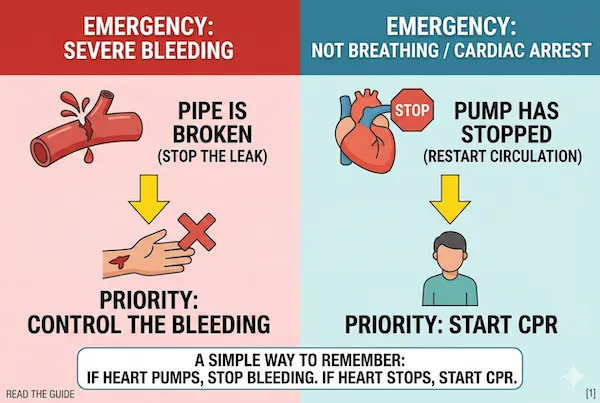
What to Do If Someone Has a Severe Bleed and is Unresponsive?
What To Do If Someone Has Severe Bleeding and Stops Breathing
Treat the biggest immediate threat to life first, then move to the next.
By Britt Brennan, REACHAU | Updated 16 October 2026
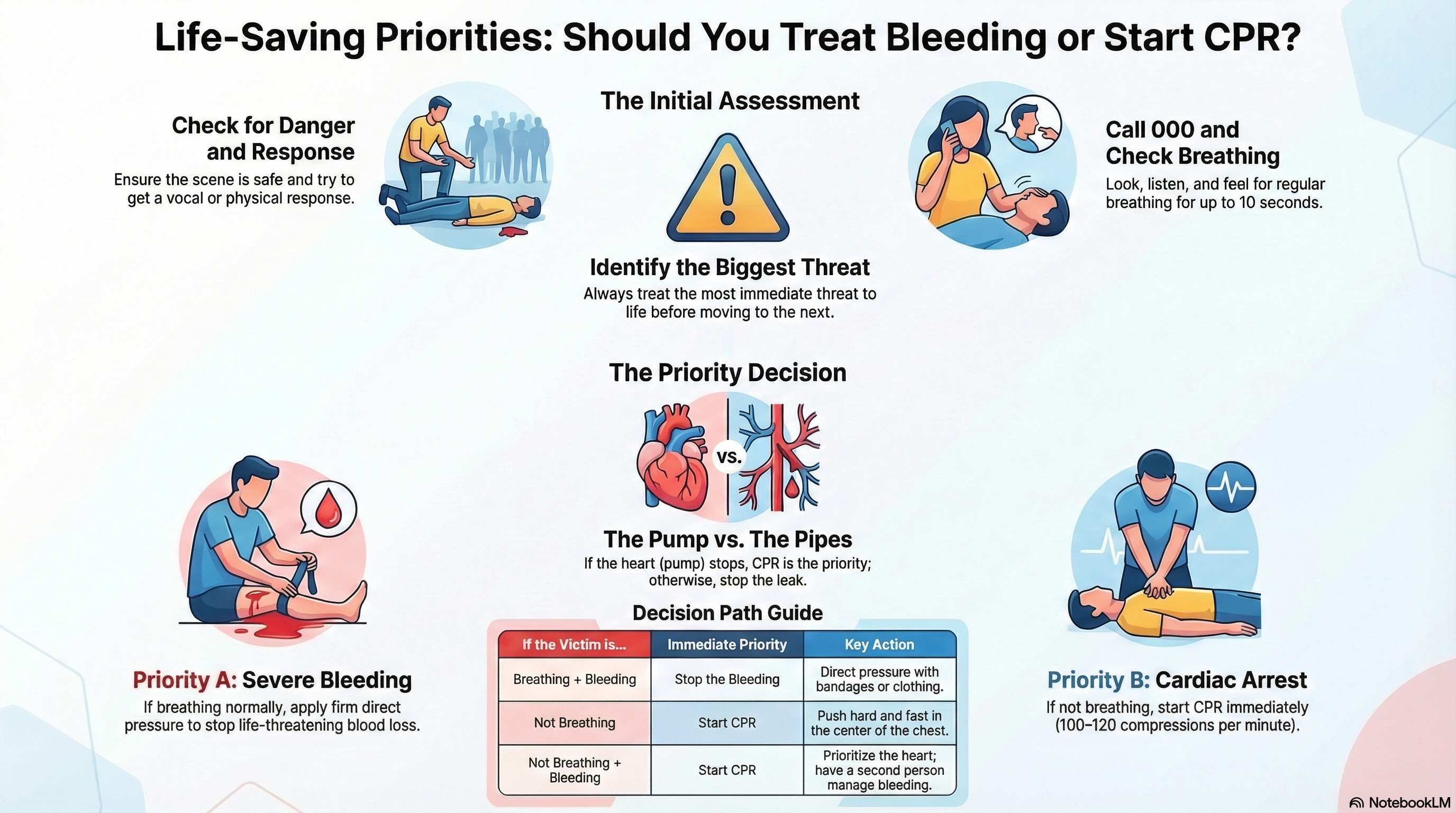
Call 000 now. If they are breathing, control the bleeding with firm pressure. If they are not breathing normally, start CPR straight away. Use an AED if one is available.
Serious injuries rarely happen neatly. In car crashes, workplace accidents, machinery incidents or major falls, people can have several life-threatening problems at once. You might see severe bleeding and notice breathing problems. A real question comes up: what do you treat first?
The answer is simpler than most people think. You do not need to be a paramedic. You just follow the priorities taught in first aid training: treat the biggest threat to life at that moment, then move to the next. Knowing that order can make the difference between freezing and taking action.
Check for danger
Before rushing in, pause and look around. Is there traffic nearby? Is machinery still running? Are there electrical hazards, fire or chemicals? Could the scene put you at risk?
If the situation is unsafe, do not approach. Call 000 and wait for emergency services. If the scene is safe, move in quickly and calmly.
Check for response and send for help
Speak loudly and gently shake the person's shoulders. Ask, "Are you okay?" If they do not respond, call 000 or send someone nearby to call. If you are alone, put your phone on speaker, stay on the line and begin first aid while the operator guides you. Emergency call-takers are trained to talk people through life-saving actions step by step.
Check for breathing
Open the airway by gently tilting the head back and lifting the chin. Look, listen and feel for breathing for up to 10 seconds. Normal breathing is regular and steady, not gasping or snorting. From here the situation usually falls into two possibilities.
If they are breathing
If the person is breathing but has severe bleeding, the bleeding is the immediate priority. Severe bleeding can become life-threatening within minutes. Signs include blood spurting or pumping from a wound, blood soaking through clothing or bandages, and a large pool of blood forming.
What to do:
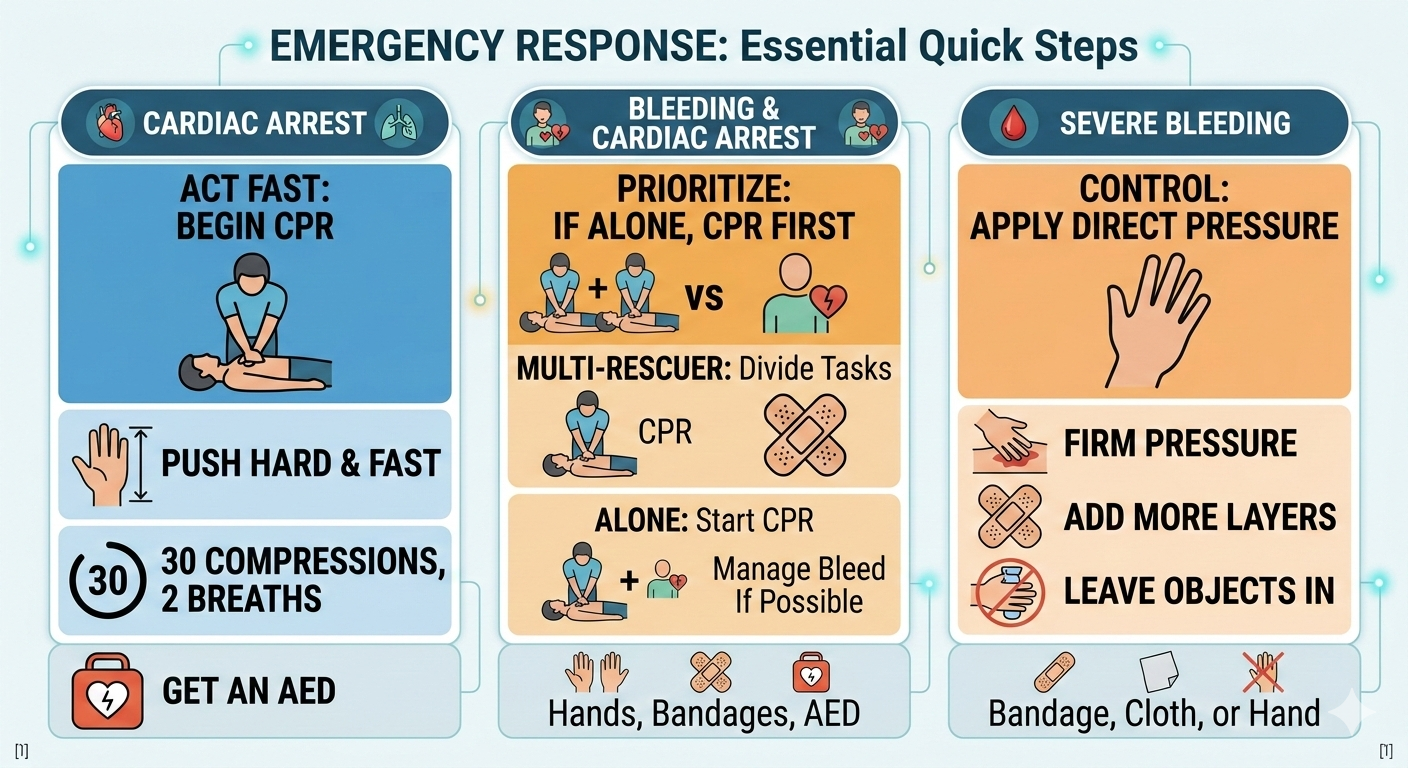
- Apply firm direct pressure to the wound with whatever is available: a bandage, clothing, a towel or your hand if necessary.
- Keep constant pressure on the wound.
- If blood soaks through, add more layers without removing the first dressing.
- If an object is stuck in the wound, do not remove it. Apply pressure around it.
Your goal is to slow the bleeding until help arrives.
If they are not breathing normally
If the person is unresponsive and not breathing normally, they may be in cardiac arrest. CPR becomes the priority.
- Place the heel of your hand in the centre of the chest, with your other hand on top.
- Push hard and fast, about one third of the depth of the chest, at 100 to 120 compressions per minute.
- Allow the chest to fully rise between compressions.
- If you are trained and confident, give 30 compressions followed by 2 breaths. If you are unsure about breaths, continue hands-only CPR.
Do not stop unless the person begins breathing normally, an AED is ready to use, emergency services take over, you are physically unable to continue or the scene becomes unsafe.
Manage bleeding if possible
If severe bleeding is still present during CPR, do what you reasonably can. If another person is available, one performs CPR and the other controls the bleeding. If you are alone, try to apply pressure without delaying CPR. If you cannot manage both, continue CPR. Emergency services understand that a single rescuer cannot do everything perfectly.
Use an AED if one is available
If someone brings an automated external defibrillator (AED), turn it on immediately and follow the voice prompts. AEDs are designed for everyday people. They guide you step by step and only deliver a shock if it is needed. Continue CPR as the AED instructs.
Why the order matters
"Should I treat the bleeding first or start CPR?" It depends on what is happening right now. If the person is breathing, severe bleeding is the immediate threat. If the person is not breathing normally, cardiac arrest is the biggest threat and CPR must start immediately.
A simple way to remember: the pump and the pipes
The heart is the pump. The blood vessels are the pipes.
If the pump is working but a pipe is broken, blood is forced out under pressure. Stop the leak.
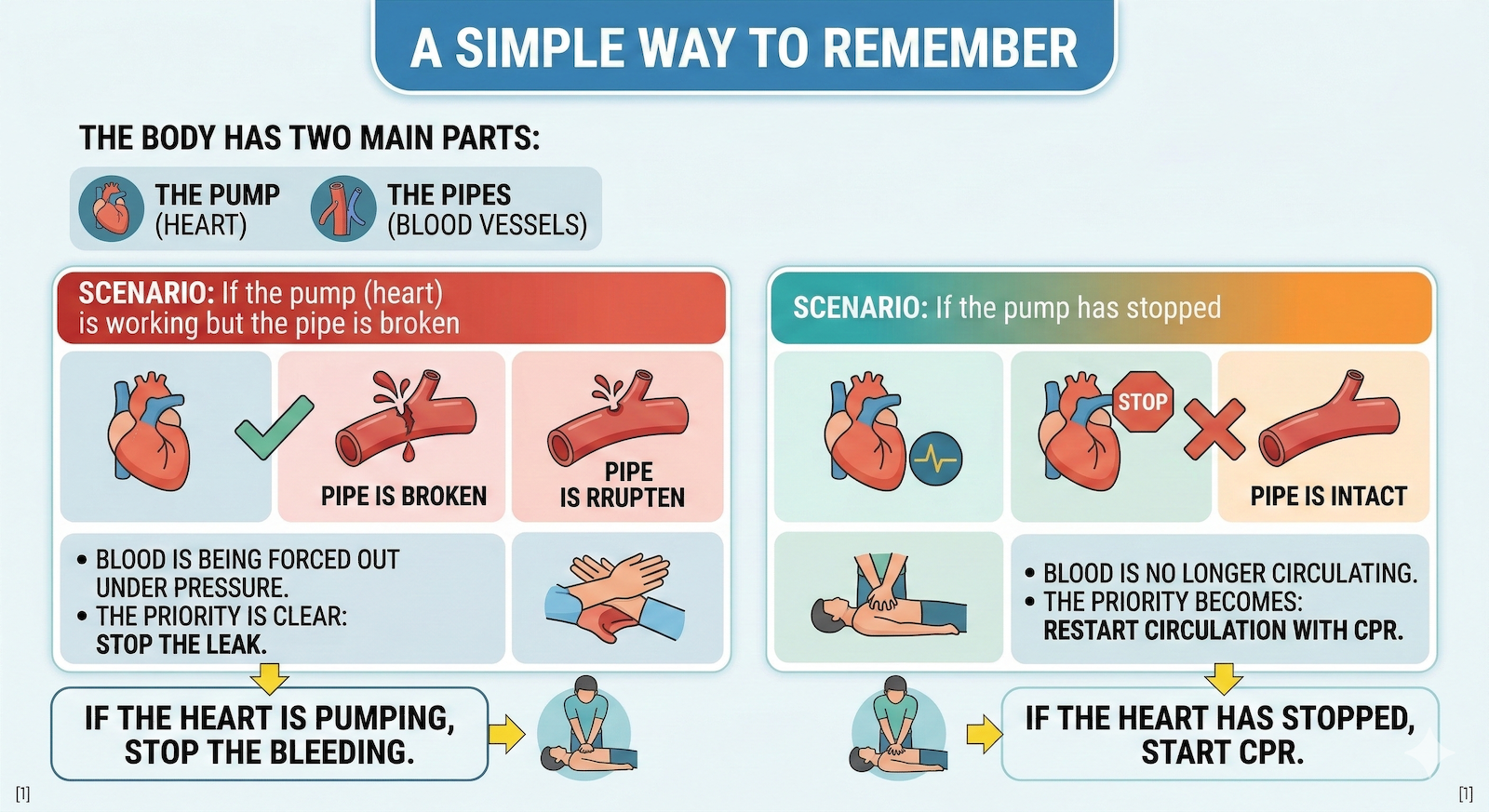
If the pump has stopped, blood is no longer circulating. Restart circulation with CPR.
If the heart is pumping, stop the bleeding. If the heart has stopped, start CPR.
What if you are not sure?
Call 000, put your phone on speaker and follow the operator's instructions. You do not need to diagnose the situation perfectly. You just need to start helping.
Why training makes this easier
Reading about first aid helps, but real emergencies are stressful and unpredictable. Training builds confidence, muscle memory, faster decision-making and the ability to stay calm under pressure. People who have practised these skills are far more likely to step in when something goes wrong. Related courses: HLTAID009 Provide CPR and HLTAID011 Provide First Aid. The accepted guideline is to refresh CPR every 12 months.
Frequently asked questions
Should I stop the bleeding or start CPR first?
It depends on whether the person is breathing normally. If they are breathing, control the bleeding with firm pressure. If they are unresponsive and not breathing normally, start CPR straight away.
What if I am on my own and the person is bleeding and not breathing?
Call 000, put your phone on speaker and start CPR. If you can press on the wound without delaying compressions, do. If you cannot manage both, keep doing CPR and follow the call-taker's instructions.
What if there are two of us?
One person does CPR while the other controls the bleeding with firm pressure. If an AED arrives, turn it on and follow the prompts.
Do I have to give breaths?
If you are trained and confident, give 30 compressions followed by 2 breaths. If you are unsure or unwilling to give breaths, continue hands-only CPR. It is far better than doing nothing.
How long do I keep doing CPR?
Keep going until the person starts breathing normally, an AED is ready to use, emergency services take over, you are physically unable to continue, or the scene becomes unsafe.
REACHAU first aid training focuses on understanding what to do, why it matters and how to act when someone needs help.
View upcoming first aid sessionsTraining and Assessment is delivered by Britt at Regional Education and Career Help Australia on behalf of ABC First Aid RTO 3399.
This article provides general first aid education and is not individual medical advice. In an emergency, call 000. Follow current ANZCOR guidance.