EpiPen, Anapen, Jext or neffy? Adrenaline Devices in Australia
EpiPen, Anapen, Jext or neffy? Adrenaline Devices in Australia Explained (2026)
More adrenaline options than ever, including a needle-free nasal spray. Here is how they differ, and the one first aid rule that never changes.
By Britt Brennan, REACHAU | Updated 16 October 2026
Suspected anaphylaxis? Lay the person flat, give adrenaline and call 000. Use whichever adrenaline device is available, following the instructions on it. If in doubt, give adrenaline.
For years, most Australians only ever saw one adrenaline device: the EpiPen. That has changed. In late 2025 the Therapeutic Goods Administration (TGA) registered two new options, the neffy adrenaline nasal spray and the Jext adrenaline injector, joining EpiPen and Anapen.
More choice is good news for people with severe allergies. It also means parents, teachers, educators, coaches and workplace first aiders may meet a device they have never held, in the middle of an emergency. This guide explains the devices, how to recognise anaphylaxis, and why adrenaline always comes first.

What is anaphylaxis?
Anaphylaxis is the most severe form of allergic reaction. It can become life-threatening within minutes. The immune system overreacts to a trigger and releases chemicals that affect several body systems at once, including the airways, the heart and blood vessels, the skin and the gut.
Common triggers include:
- Foods such as peanuts, tree nuts, sesame, fish, shellfish, egg, cow's milk, soy and wheat
- Insect stings and bites, including bees, wasps and jack jumper ants
- Medicines, including some antibiotics and anti-inflammatory drugs
- Latex
- Occasionally exercise, especially when combined with certain foods
Anyone can have anaphylaxis, including people who have never had a serious reaction before. Many people who have anaphylaxis have no prior diagnosis. That is why every first aider, not just those caring for someone with a known allergy, needs to recognise it.
How to recognise anaphylaxis
Anaphylaxis can develop within seconds, or may take 30 minutes or more to appear after exposure to a trigger. Symptoms often involve more than one body system.
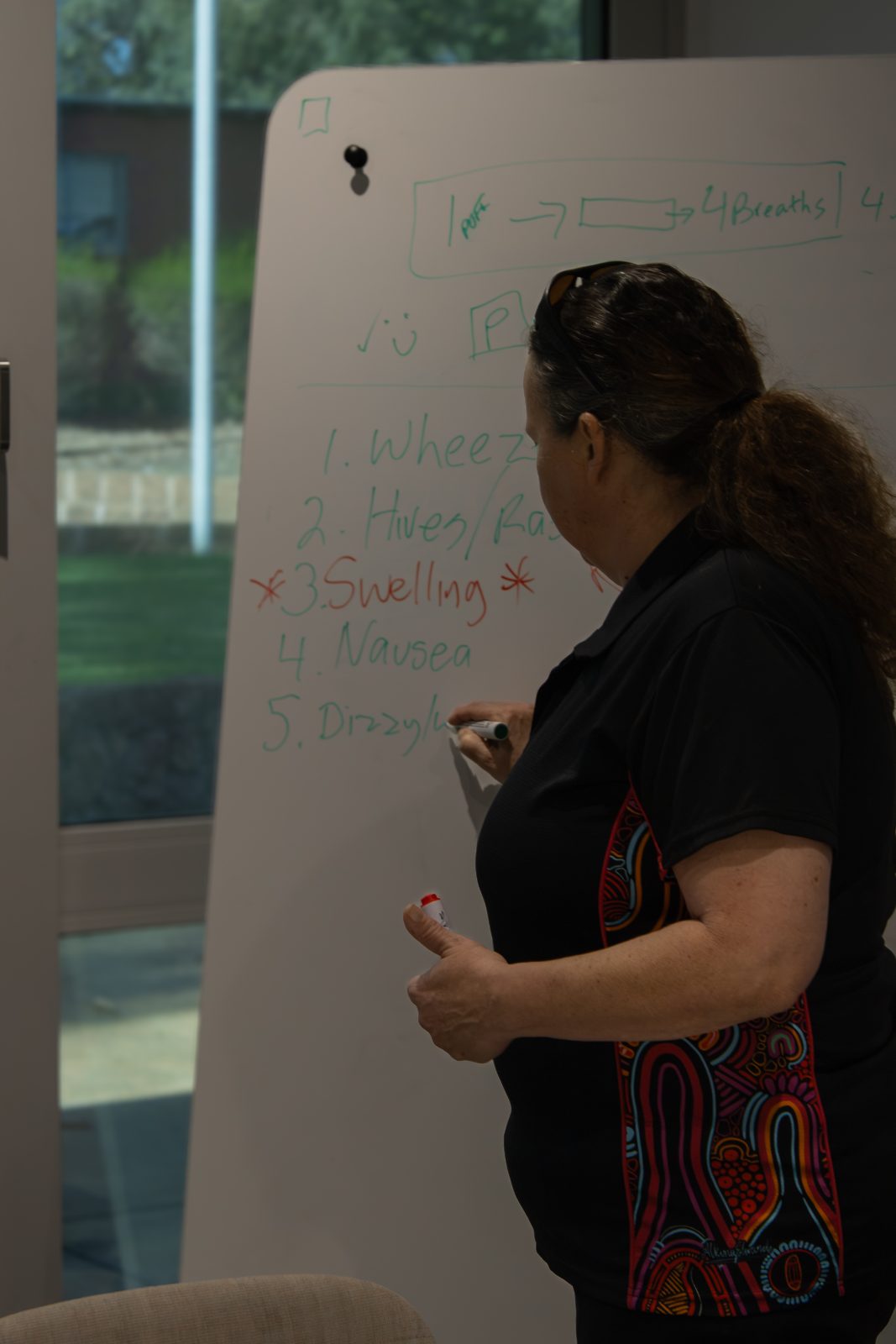
Signs of anaphylaxis (any one of these):
- Difficult or noisy breathing
- Swelling of the tongue
- Swelling or tightness in the throat
- Wheeze or persistent cough
- Difficulty talking or a hoarse voice
- Persistent dizziness or collapse
- Pale and floppy (in young children)
- Sudden sleepiness, abdominal pain or vomiting after an insect sting
Milder allergic signs, such as hives, welts, swelling of the lips, face or eyes, tingling in the mouth, and abdominal pain or vomiting, can be the start of anaphylaxis. Stay with the person and watch closely for any of the signs above.
No rash does not mean no anaphylaxis
Not every reaction involves hives or a visible skin change. Some of the most dangerous reactions show up mainly as breathing difficulty or collapse. If breathing or circulation is affected after contact with a likely trigger, treat it as anaphylaxis.
Anaphylaxis can look like asthma
For people with both asthma and allergies, anaphylaxis can look almost identical to a severe asthma attack. Coronial findings from several Australian deaths show how easily this confusion happens. Read why adrenaline comes before the inhaler, lessons from Max McKenzie's inquest and the James Tsindos coronial inquest for the full picture.

Why adrenaline always comes first
Adrenaline (also called epinephrine) is the first-line treatment for anaphylaxis. Nothing else does what it does in the first minutes of a severe reaction. It relaxes the muscles around the airways, reduces swelling in the throat and airways, tightens blood vessels to raise dangerously low blood pressure, supports the heart and reduces the release of more allergic chemicals.
Antihistamines do not treat the serious symptoms of anaphylaxis. They act too slowly and do not reverse airway swelling or low blood pressure. Asthma relievers help the airways but do nothing for circulation. Using either as a first response wastes critical time.
If in doubt, give adrenaline. Adrenaline is safe for most people when given in an emergency. The risk of giving it when it was not needed is far lower than the risk of giving it too late.
The adrenaline devices in Australia
This overview is summarised from information published by ASCIA (the Australasian Society of Clinical Immunology and Allergy) and the TGA. Always follow the instructions on the device, the person's ASCIA Action Plan and their doctor's advice. Check ASCIA for current availability.
| Device | Type | Dose options | Who it is for |
|---|---|---|---|
| EpiPen | Autoinjector | EpiPen 300 micrograms, EpiPen Jr 150 micrograms | EpiPen for adults and children over 20 kg. EpiPen Jr for children 7.5 to 20 kg. |
| Anapen 500 | Autoinjector | 500 micrograms | A higher-dose device prescribed by a doctor, usually for larger teenagers and adults. Availability has varied, so check with your pharmacist. |
| Jext | Autoinjector | Jext 300 micrograms, Jext Jnr 150 micrograms | Jext for adults and children 20 kg and over. Jext Jnr for children 7.5 to 20 kg. Registered by the TGA in November 2025. |
| neffy | Nasal spray (needle-free) | 2 mg and 1 mg | 2 mg for adults and children 30 kg and over. 1 mg for children aged 4 and over weighing 15 to 30 kg. Registered by the TGA in December 2025. |
Pricing, availability and PBS subsidy differ between devices and can change. Your doctor or pharmacist can tell you which options suit you and what they cost.

EpiPen: the device most people know
EpiPen has been the most widely used adrenaline autoinjector in Australia for many years. Most first aid courses, schools and workplaces train with EpiPen trainers, and many people know the rhyme: "Blue to the sky, orange to the thigh."
How to give an EpiPen
- Form a fist around the EpiPen and pull off the blue safety release.
- Hold the leg still and place the orange end against the outer mid-thigh. It can go through clothing.
- Push down hard until you hear or feel a click, and hold it in place for 3 seconds.
- Remove the EpiPen.
Then lay the person flat, call 000 and follow the first aid steps below. Give the used device to the paramedics and tell them the time it was given.
Anapen 500: a higher-dose autoinjector
Anapen is another adrenaline autoinjector. The current Anapen device listed by ASCIA is Anapen 500, which delivers 500 micrograms of adrenaline. A doctor may prescribe it based on body weight and individual needs. It looks and works differently from EpiPen: the caps, colours and the way you activate it are not the same. That is why it matters to practise with the right trainer. If you care for someone who carries Anapen, ask for a trainer device and run through the steps on it and the ASCIA instructions until they feel automatic.
Jext: a new autoinjector option
Jext is an adrenaline autoinjector registered by the TGA in November 2025. It comes in two doses, Jext 300 micrograms and Jext Jnr 150 micrograms, with weight ranges similar to EpiPen and EpiPen Jr. Like every autoinjector, it is given into the outer mid-thigh and can go through clothing. The steps, including how you remove it from its case and how the safety cap works, are specific to the device. ASCIA publishes step-by-step instructions for each device on its how to give adrenaline devices page.
neffy: a needle-free adrenaline option
neffy is an adrenaline nasal spray. Instead of an injection into the thigh, it delivers adrenaline through the lining of the nose. It was registered by the TGA in December 2025.
Why neffy matters
Fear of needles is one reason people, especially parents and children, delay giving adrenaline. Every minute of delay matters in anaphylaxis. A needle-free option may help some people give adrenaline sooner.
How neffy is used
neffy is a single-use spray. You do not prime or test it. It is placed in one nostril and the plunger is pressed firmly to give the full dose. If symptoms do not improve after 5 minutes, ASCIA guidance is to give a second dose with a new neffy device, ideally in the same nostril. A second dose of injectable adrenaline can be used instead if that is what is available.
Doses
- neffy 2 mg for adults and children weighing 30 kg and over
- neffy 1 mg for children aged 4 years and older who weigh 15 to 30 kg
neffy is not suitable for every person or situation. It is a prescription decision between the person and their doctor. For first aiders the key message is simple: if the person's action plan names neffy and that is the device they have, use it at the first signs of anaphylaxis, exactly as you would an autoinjector.
Questions to ask your doctor about devices
- Which device and dose suit my weight, age and lifestyle?
- Is a needle-free option appropriate for me or my child?
- How many devices should I carry, and where should I keep a spare?
- What does each device cost, and is it subsidised?
- Can I get a trainer device to practise with, and to share with school, childcare or my workplace?
- Does my ASCIA Action Plan need updating to show the device I now carry?
Anaphylaxis first aid, step by step
The device may change. The first aid does not. These steps follow the ASCIA first aid approach.
- Lay the person flat. Do not let them stand or walk. If they have trouble breathing, let them sit with their legs out straight. If they are pregnant, lay them on their left side. Hold young children flat, not upright.
- Give adrenaline. Use their prescribed device, or a general use device if theirs is not available, following the instructions on the device.
- Call 000 for an ambulance. Every person who has had anaphylaxis needs to go to hospital, even if they seem to recover.
- Phone a family member or emergency contact.
- Give a further dose of adrenaline if there is no response after 5 minutes.
- If the person becomes unresponsive and is not breathing normally, start CPR.
- Stay with them and keep them lying down until paramedics take over. Give the used device to the paramedics and tell them the time it was given.
What happens at hospital
Hospital staff assess the person, give further treatment if needed and usually observe them for several hours, because symptoms can come back. Before going home, the person should have a current ASCIA Action Plan, a prescription to replace any device that was used, and a follow-up plan with their doctor or an allergy specialist.
Asthma and allergy together
If someone with a known allergy and asthma has sudden breathing difficulty, including wheeze, persistent cough or a hoarse voice, give adrenaline first, then asthma reliever medication. Do not wait to see whether the puffer works. After anaphylaxis the person must be observed in hospital, because symptoms can return after the first dose wears off (a biphasic reaction).
Laying flat matters more than people think
During anaphylaxis, blood vessels relax and blood pressure can drop suddenly. If a person stands up, walks or is held upright, there may not be enough blood returning to the heart. This can cause sudden collapse and cardiac arrest. So:
- Do not walk the person to the first aid room, sick bay, car or ambulance. Bring help to them.
- Do not let them stand up, even if they feel better after adrenaline.
- Do not hold a young child upright on your shoulder. Hold them lying flat on your lap or on the floor.
- If they struggle to breathe lying down, let them sit with legs out straight.
Common mistakes with adrenaline devices
- Waiting too long. Hoping symptoms will settle loses precious minutes.
- Giving antihistamine or a puffer first. Neither treats anaphylaxis.
- Injecting into the thumb. This happens when an autoinjector is held the wrong way round. Practise with a trainer.
- Not holding it long enough. Hold autoinjectors in place for the time stated on the device.
- Letting the person walk. Standing and walking can trigger collapse.
- Not calling 000. Everyone who has had adrenaline for anaphylaxis needs to go to hospital.
- Expired or overheated devices. Devices kept in hot cars, sheds or glove boxes may not work properly.
- Leaving the device at home. A device only works if it is with the person.
See also the 7 anaphylaxis first aid mistakes that cost time in WA.
Storing and checking adrenaline devices
- Keep devices at room temperature and follow the packaging instructions. Do not refrigerate them or leave them in a hot car, ute, shed or direct sun.
- Check expiry dates. Set a phone reminder a month before each device expires.
- Check the window. For autoinjectors with a viewing window, replace the device if the liquid is cloudy or discoloured.
- Keep the action plan with the device.
- Carry it everywhere. Many people are advised to carry two devices in case a second dose is needed.
For remote workers and travellers in the north of WA, plan ahead for heat. An insulated pouch can help keep devices in a safe temperature range.
What schools, childcare and workplaces need to know
- Know the devices your people carry. Make sure it is written on their action plan and individual health care plan, and that staff know how that specific device works.
- Train with the right trainers. Trainer devices contain no adrenaline or needle and are the best way to build confidence. If your team only practises with one brand, add the others to your refreshers.
- Check general use devices. Many schools, childcare services and workplaces keep a general use device. Store it correctly, check it regularly and make it easy to find.
- Update plans and policies. Review your anaphylaxis policy, risk minimisation plans and emergency procedures. ASCIA updated its action plans and device instructions in December 2025, so use current versions.
Education and care staff should hold current training. HLTAID012 Provide First Aid in an Education and Care Setting covers anaphylaxis and asthma management for children. See also why every WA school, club and workplace needs regular anaphylaxis training.

Anaphylaxis in the workplace
Anaphylaxis is not only a school and childcare issue. Adults have severe allergic reactions at work in offices, kitchens, construction sites, farms and mine sites.
- Shared food. Morning teas, catered meetings and shared kitchens create risk. Clear labelling and a culture of asking before sharing help.
- Insect stings outdoors. Gardeners, farm workers, rangers and road crews may be stung, and some will not know they are allergic until it happens.
- Medications and latex. Health and care workers may be exposed through their work.
- Remote sites. A second dose may be needed long before help arrives. Carrying two devices and having a general use device in the site kit are important.
Employers should include anaphylaxis in first aid risk assessments, make sure first aiders are trained and encourage workers with known allergies to share their action plan. Workers do not have to disclose health conditions, but telling a few trusted colleagues where the device is kept is a simple, powerful safety step.
Travelling with an adrenaline device
- Carry devices in hand luggage, never checked baggage, where they could be lost or exposed to extreme temperatures.
- Bring your ASCIA Action Plan and consider a letter from your doctor, especially for international travel.
- Protect devices from heat in cars, on boats and at the beach.
- Check expiry dates before you leave.
- Research medical help at your destination.
- Tell travel companions where your device is and how to use it.
Talking to children about their device
- Explain that the device is "medicine that helps your breathing and your heart when you have a bad allergy".
- Let them hold and practise with a trainer device.
- Teach them to tell an adult straight away if their mouth feels funny, their throat feels tight or they feel sick after eating.
- As they get older, teach them to recognise their own symptoms and, when ready, to give their own device.
- Make sure friends' parents, coaches and grandparents know where the device is and how to use it.
For some children with a strong fear of needles, a needle-free option such as neffy may be worth discussing with their doctor.
Example scenario: a new device on camp
This is a fictional example to show how practice helps. A Year 6 school camp is running at a coastal campsite in the South West. Ava, who has a peanut allergy, eats a biscuit from a friend's snack pack. Within minutes she is coughing and says her throat feels tight.
Her teacher, Sam, remembers that Ava's action plan names neffy, not an EpiPen. Sam has only practised with EpiPen trainers, but at a refresher the trainer had walked the group through each device.
- Sam lays Ava flat and asks another teacher to call 000.
- Sam takes the neffy from Ava's medical kit, places it in one nostril and presses the plunger firmly, following the steps on the device.
- A third adult calls Ava's parents.
- Ava is still wheezy after 5 minutes, so Sam gives a second neffy in the same nostril.
- Sam keeps Ava lying down and watches her breathing until paramedics arrive.
Ava is taken to hospital and observed. Holding an unfamiliar device in an emergency is stressful. Having held it before makes it manageable.
Why hands-on training matters more than ever
When there was mainly one device, one set of instructions was enough. Now first aiders may face different shapes, caps and methods, including a nasal spray. Reading helps. Holding and practising builds the automatic confidence you need under pressure. In REACHAU courses you practise recognising anaphylaxis in realistic scenarios (including reactions without a rash), handle trainer devices, practise laying a casualty flat and calling for help, learn the link between asthma and anaphylaxis, and practise CPR in case the person stops breathing.
Anaphylaxis is covered in HLTAID011 Provide First Aid, HLTAID012 for education and care, and HLTAID014 Provide Advanced First Aid.
The device may change. The rule does not. Recognise the signs, lay them flat, give adrenaline, call 000. Practise it until your hands know what to do.
Frequently asked questions
Is neffy available in Australia?
neffy adrenaline nasal spray was registered by the TGA in December 2025. It needs a prescription, so talk to your doctor about whether it suits you, and check current availability with your pharmacist.
Is neffy as good as an EpiPen?
Both deliver adrenaline to treat anaphylaxis. Which device is right depends on the person and their doctor's advice. For first aiders the rule is the same: give whichever device is available straight away.
How do you use neffy nasal spray?
Do not prime or test it. Place it in one nostril and press the plunger firmly. If symptoms do not improve after 5 minutes, give a second dose with a new device, ideally in the same nostril.
What is the difference between EpiPen and EpiPen Jr?
EpiPen delivers 300 micrograms of adrenaline for adults and children over 20 kg. EpiPen Jr delivers 150 micrograms for children weighing 7.5 to 20 kg.
What is Jext?
Jext is an adrenaline autoinjector registered by the TGA in November 2025. It comes as Jext 300 micrograms and Jext Jnr 150 micrograms and is given into the outer mid-thigh.
Should I give an antihistamine for anaphylaxis?
Not as the first treatment. Antihistamines do not treat airway swelling or low blood pressure. Give adrenaline first, lay the person flat and call 000.
Can an adrenaline autoinjector go through clothing?
Yes. Autoinjectors can be given through clothing into the outer mid-thigh. Avoid seams, pockets and thick items in the way.
What if I am not sure it is anaphylaxis?
If in doubt, give adrenaline. The risk of giving it when it was not needed is much lower than the risk of giving it too late. Then call 000.
Does everyone need to go to hospital after using adrenaline?
Yes. Call 000 after giving adrenaline. Symptoms can return after the first dose wears off, so the person needs to be observed in hospital.
Can I use someone else's adrenaline device in an emergency?
In a life-threatening emergency, giving any available adrenaline device is far better than giving none. Many schools and workplaces keep a general use device for this reason. Call 000 as well.
REACHAU first aid training focuses on understanding what to do, why it matters and how to act when someone needs help.
View upcoming first aid sessionsTraining and Assessment is delivered by Britt at Regional Education and Career Help Australia on behalf of ABC First Aid RTO 3399.
This article is general first aid information based on ASCIA and ANZCOR guidance current at the time of writing. It does not replace medical advice, an ASCIA Action Plan or a first aid course. Always follow the instructions for the specific device. In an emergency, call 000.