Beyond the Label: Allergy and Anaphylaxis Lessons Australia
Allergy and Anaphylaxis Awareness Week
Help raise awareness and support for people living with severe allergies.
Every dollar helps fund education, advocacy and resources that could save a life. Please consider supporting this campaign.
Donate to My Fundraising Page →
Anaphylaxis & Allergy Safety
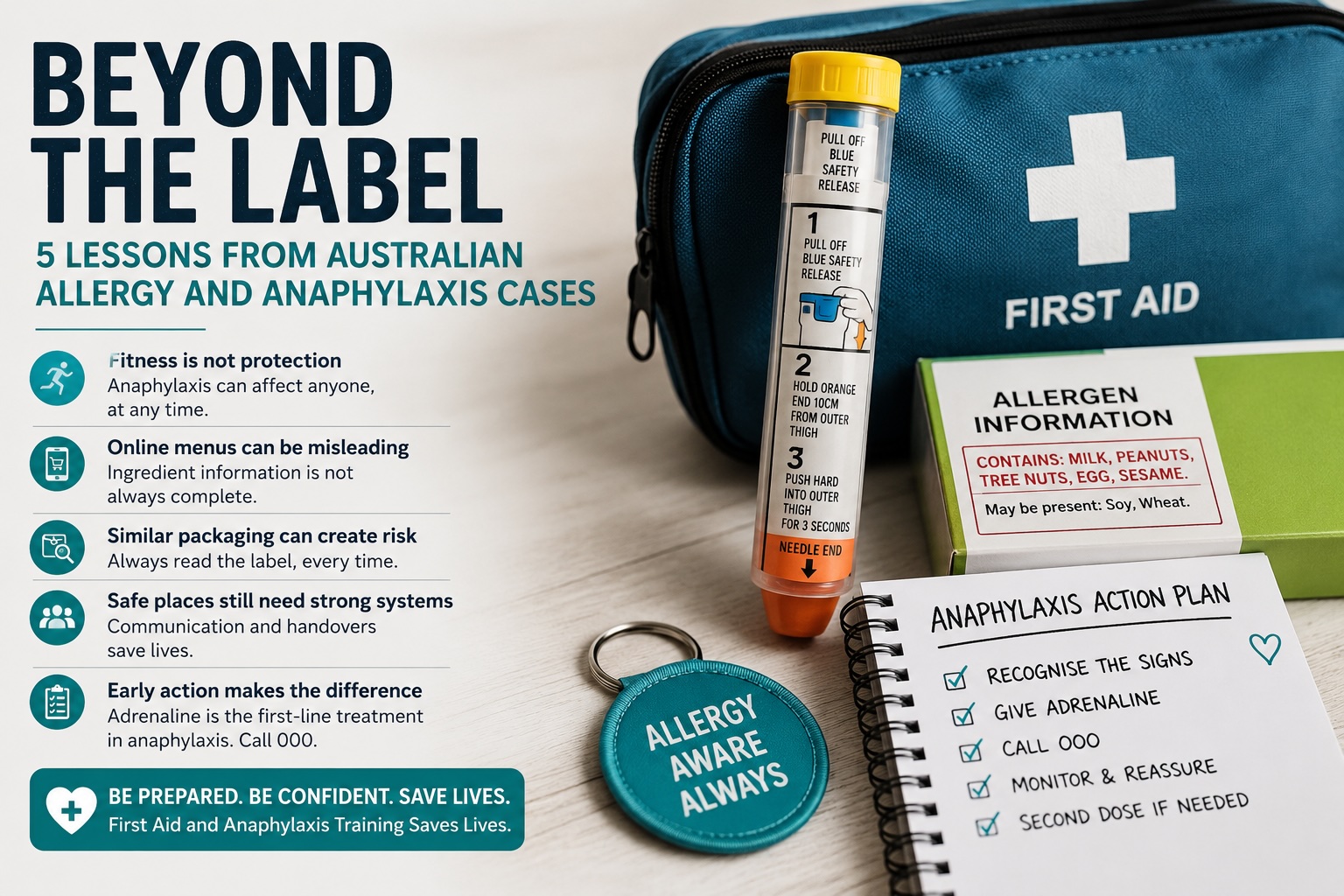
Beyond the Label: 5 Lessons from Australian Allergy and Anaphylaxis Cases
Food allergy safety is often talked about as if it is simple. Read the label. Avoid the food. Carry the EpiPen. But some of the most serious Australian allergy incidents have not happened because nobody knew. They have happened because the information did not reach the right person at the right time.
That sounds straightforward until you look at what has actually happened.
The label was easy to miss. The menu was incomplete. The system relied too heavily on someone remembering instead of having a clear process.
Anaphylaxis is not just a medical issue. It is also a communication issue, a systems issue and a training issue.
This article looks at five practical lessons from Australian allergy and anaphylaxis cases, including food labelling, online ordering, packaging confusion, institutional handovers and the importance of acting early.
Quick Answer
What do Australian allergy and anaphylaxis cases teach us?
▶ Serious reactions can happen even when people are careful.
▶ Physical fitness does not protect someone from anaphylaxis.
▶ Online menus may not show every ingredient or cross-contamination risk.
▶ Similar packaging can create real risk even for experienced label-readers.
▶ Schools, hospitals, camps and food businesses need clear written systems, not just verbal handovers.
▶ In an anaphylaxis emergency, adrenaline is the first-line treatment and delays can cost lives.
Why this matters
When anaphylaxis happens, people often freeze because they are unsure.
In the moment, people often ask themselves:
→ Is this really anaphylaxis?
→ Should I wait and see?
→ Should I give asthma medication first?
→ What if I give adrenaline and I am wrong?
→ Where is the person's action plan?
→ Who has the autoinjector?
→ Has someone called 000?
That hesitation is dangerous. The point of First Aid training is not to tick a compliance box. It is to help people recognise what is happening, understand why the first actions matter, and respond with confidence.
Lesson 1
Fitness does not protect someone from anaphylaxis
One dangerous assumption is that a strong, healthy or physically fit person will cope better in a severe allergic reaction. That is not how anaphylaxis works.
Anaphylaxis is a severe allergic reaction that can affect breathing, circulation, skin, gut symptoms and consciousness. It can progress quickly. A person's fitness level does not stop the immune response.
In one Victorian coronial case, the person involved was described as strong, fit and health conscious. He had completed an Ironman challenge two years before his death. He still died from an anaphylactic reaction involving macadamia nuts.
That matters because people sometimes underestimate risk when the person looks healthy. They may think: he looks fit, she is young, they will be okay, we can wait a bit longer.
The practical lesson
Physical fitness does not give protection from anaphylaxis.
The correct response is early recognition, adrenaline as the first-line treatment, calling 000, positioning the person correctly, monitoring them, and being ready to give a second dose if symptoms do not improve or return. If the person becomes unresponsive and is not breathing normally, CPR is required.
This is exactly why training matters. People need to know what to do before the emergency happens. Our HLTAID011 Provide First Aid course covers anaphylaxis recognition and response in a practical, hands-on format.
Lesson 2
Online menus can create a false sense of safety
Online food ordering has made life more convenient, but it has also created a serious problem for people with food allergies.
A menu description is not the same as a full ingredient list. A third-party delivery app may show a short description, a product name or a general menu label. That does not always tell the full story of what is in the food, how it was prepared, or whether there is a cross-contamination risk.
In the Victorian case mentioned above, the dessert was described in a way that could lead a person to believe it contained a familiar commercial product. The business used an in-house nut mixture that included macadamia. A person may see a familiar word like "Nutella" and assume they know what is in the food. In a commercial kitchen, that word may be used to describe a chocolate-nut style spread, dessert base or house-made mixture. For someone with a severe allergy, that assumption can be fatal.
The practical lesson
Do not rely only on a short online menu description if you have a serious allergy. If the allergen risk is unclear, contact the food business directly, ask specific questions, ask about cross-contamination, and avoid ordering if the answer is vague. Do not assume a brand name means the exact commercial product has been used.
For food businesses, this is a reminder that casual wording can create real risk. If staff cannot clearly explain what is in a menu item, that is a training gap that needs to be closed.
Lesson 3
Similar packaging makes label checking harder
People often say "just read the label." That sounds simple until you are standing in a supermarket aisle with several products from the same range, similar colours, similar branding and small differences in the ingredient panel.
For families managing severe food allergies, label checking is not a quick glance. It is a constant safety task. One Australian case involving a child highlighted the risk of very similar packaging across different biscuit varieties. One product may be safe for that person, while another product in almost identical packaging may contain the allergen as an ingredient.
This is why Plain English Allergen Labelling (PEAL) matters. PEAL is designed to make allergen declarations clearer and more consistent in Australia. It helps people identify common allergens using plain, standardised terms. That is a positive step, but it does not remove the need for careful checking.
The practical lesson
Check the label every time. Do not rely on familiar packaging, previous purchases, brand recognition, product colour, shelf location or memory. Manufacturers can change ingredients. Similar products can contain different allergens.
For schools, childcare services, camps and workplaces, this matters when food is purchased for groups. Someone needs to be responsible for checking the actual product, not just assuming it is the same as before.
Lesson 4
"Safe" places still need strong systems
Some of the hardest allergy cases to read are the ones that happen in places where people expect extra safety. Schools. Hospitals. Camps. Childcare services. Aged care. Workplaces.
These environments usually have policies. They may have forms. They may have documented allergies. They may have trained staff. But documentation is only useful if it changes what happens in practice.
If the allergy is written on a form but not communicated to the kitchen, the risk remains. If one staff member knows but the next shift does not, the risk remains. If everyone assumes someone else has checked, the risk remains.
The death of Louis Oliver Tate at Frankston Hospital is often discussed because it involved a known milk allergy in a healthcare setting. His allergy had been documented, yet he was still exposed to food that triggered anaphylaxis. The review into the incident identified problems with communication, handover and food service processes. One key issue was the reliance on informal communication instead of clear, consistent safeguards.
The practical lesson
A known allergy must be visible, communicated and built into the system. That means clear written records, visible allergy alerts, staff handover processes, food preparation controls, clear responsibility for checking meals, and no relying on one person's memory.
In a real workplace, school or care setting, allergy safety cannot depend on the most careful person being rostered on that day. The system needs to support safe decisions every time. Our HLTAID012 First Aid in an Education and Care Setting course covers exactly this kind of system-level thinking for schools and childcare services.
Lesson 5
Verbal handovers are not enough
A professional handover can feel reassuring. The person has told the school. The parent has told the camp. The allergy is in the hospital notes. The workplace has been informed. The staff member said they would pass it on.
But verbal handovers can fail. People get busy. Shifts change. Notes get missed. Staff assume someone else knows. Food gets delivered by someone who was not part of the original conversation.
That is why allergy management needs more than good intentions. It needs clear, visible, repeatable processes. If a person has a known risk of anaphylaxis, the people responsible for their care or food service need to know:
✓ What the allergy is
✓ What the person must avoid
✓ Where the action plan is
✓ Where the adrenaline autoinjector is
✓ Who is responsible for checking food
✓ What to do if symptoms appear
✓ When to call 000
✓ How to give adrenaline
Practical training reduces hesitation and gives people a clear response pathway. Not because training removes every risk, but because it prepares people to act with confidence when it counts. See our full course list or check the FAQ page for common questions about training requirements.
Emergency Response
What to do if someone is having anaphylaxis
Follow their ASCIA Action Plan if available. General steps:
1
Lay the person flat. Do not allow them to stand or walk. If breathing is difficult, allow them to sit with legs outstretched.
2
Give adrenaline using an autoinjector. Adrenaline is the first-line treatment. Use it if prescribed or available, following the person's action plan.
3
Call 000. Say the person is having anaphylaxis. Do not wait to see if symptoms improve before calling.
4
Give a second dose if needed. If symptoms do not improve or return after approximately 5 minutes, give a second adrenaline autoinjector if available.
5
Monitor breathing and responsiveness. Be ready to start CPR if the person becomes unresponsive and is not breathing normally.
6
Do not leave them alone. Keep monitoring until ambulance help arrives.
Do not wait for the reaction to become catastrophic before acting. If the signs point to anaphylaxis, treat it as anaphylaxis.
Why workplaces, schools and food businesses need training
Anaphylaxis training is not only for people with allergies or their families. It is important for anyone who serves food, supervises children, runs activities, manages public spaces or works with vulnerable people.
This is especially important because anaphylaxis does not always look dramatic at the start. Someone may first report a tight throat, trouble breathing, a hoarse voice, dizziness, swelling, widespread hives, severe abdominal symptoms, or a sense that something is very wrong. If staff are waiting for every possible symptom to appear, they may wait too long.
Environments where anaphylaxis training is essential:
✓ Schools and childcare services
✓ Hospitality businesses
✓ Food trucks and market stalls
✓ Sports clubs and camps
✓ Community groups and events
✓ Workplaces of all types
✓ Aged care and support services
✓ Remote and regional sites
Also worth reading: Asthma or Anaphylaxis? Why Adrenaline Comes Before the Inhaler, which covers the specific challenge of overlapping symptoms and why the order of treatment matters.
The bigger issue: safety needs to be practical
The cases in this article all point to the same issue. Safety cannot rely on assumptions.
“They look healthy.”
“The menu would say if it had nuts.”
“We bought this product before.”
“The allergy is written somewhere.”
“Someone must have told the kitchen.”
“The staff member said it should be fine.”
That is not a system. That is hope.
Real safety comes from clear information, practical training, visible action plans, careful food handling and people who are confident enough to act early.
Allergy and Anaphylaxis Awareness Week
I am raising funds to support allergy and anaphylaxis awareness in Australia.
If this article has been useful to you, please consider making a donation. Every contribution helps fund education and advocacy for people living with severe allergies.
Final thoughts
Food allergy and anaphylaxis management is not about panic. It is about preparation.
People with allergies already carry a heavy load. They check labels, ask questions, carry medication, explain their needs and often have to advocate for themselves in situations where others do not understand the risk.
The rest of us need to do better.
If you run a workplace, school, childcare service, food business, community group or event, train your people, make the allergy information visible, check the food properly, use written systems, know where the adrenaline autoinjector is, call 000 early, and act quickly. In an emergency, the most important skill is staying calm and taking the first correct action.
REACHAU First Aid Training
Need First Aid or anaphylaxis training?
REACHAU delivers practical, empowerment-focused First Aid training across Perth and regional Western Australia. Training and assessment for nationally recognised units is delivered on behalf of ABC First Aid RTO 3399.
AVAILABLE COURSES
› HLTAID009 Provide Cardiopulmonary Resuscitation
› HLTAID012 Provide First Aid in an Education and Care Setting
› HLTAID013 Provide First Aid in Remote or Isolated Site
› HLTAID014 Provide Advanced First Aid
Related Articles
Asthma or Anaphylaxis? Why Adrenaline Comes Before the Inhaler
Pressure Immobilisation Technique: Why It Works for Snakebite
Allergy and Anaphylaxis Awareness Week
Help support allergy awareness and education in Australia.