Online First Aid Courses in Australia: What You Must Check Before Enrolling
Online First Aid Courses in Australia: What You Need to Know Before You Enrol
A Quiet Problem Growing in the First Aid Training Industry
Over the past year there has been a noticeable increase in advertising for “100% online First Aid certificates.”
The ads usually promise something appealing.
Fast completion.
No classroom time.
Cheap prices.
Instant certificate.
At first glance that sounds convenient.
For busy workplaces, parents, or people trying to meet job requirements quickly, it looks like an easy solution.
But there is a serious issue that many people do not realise until it is too late.
Some of these courses are not compliant with the rules governing nationally recognised training in Australia.
Some of these companies are not even based in Australia and the certificates issued are not compliant in Australia, along with teaching some techniques that are not approved in Australia.
Even worse, when regulators investigate training providers that have assessed practical skills online, certificates can be cancelled after they have already been issued.
When that happens the certificate becomes invalid.
Sometimes the person holding that certificate is never contacted.
They continue believing they are qualified and compliant when they are not.
For workplaces that rely on that qualification to meet safety obligations, that can become a serious problem.
For individuals who think they are trained to help in an emergency, the consequences can be even more significant. Some methods trained in other countries are considered dangerous by the Australian Resuscitation Council such as the Heimlich Procedure which has been shown by multiple studies to cause more damage to the casualty when other methods such as 5 back blows, 5 chest thrusts repeated is just as if not more effective with little damage beyond bruising.
This article explains what is happening, why it matters, and how to make sure the First Aid course you choose actually delivers what you need.

There is a simple reason why practical First Aid assessment exists.
First Aid is a physical skill.
You cannot truly learn it by watching a video.
Think about the key actions involved in a real emergency.
CPR compressions
Using an AED
Managing severe bleeding
Placing someone in the recovery position
Treating shock
Immobilising injuries
These are hands on actions that must be demonstrated under supervision.
A trainer needs to see that a participant can actually perform the skills safely and correctly.
This requirement is built into the Australian training framework.
Nationally recognised courses such as:
all include practical assessment requirements.
These requirements exist for one reason.
Lives may depend on it.
A certificate should mean that the person holding it can actually step in and help during a real emergency.
How Some Providers Are Bending the Rules
Online learning is not the problem.
In fact,online theory learning is common and often very effective.
Many legitimate First Aid courses use a blended format where:
Theory content is completed online
Practical skills are assessed in person
This approach works well.
Participants can learn the knowledge at their own pace, then attend a session to practise and demonstrate the skills.
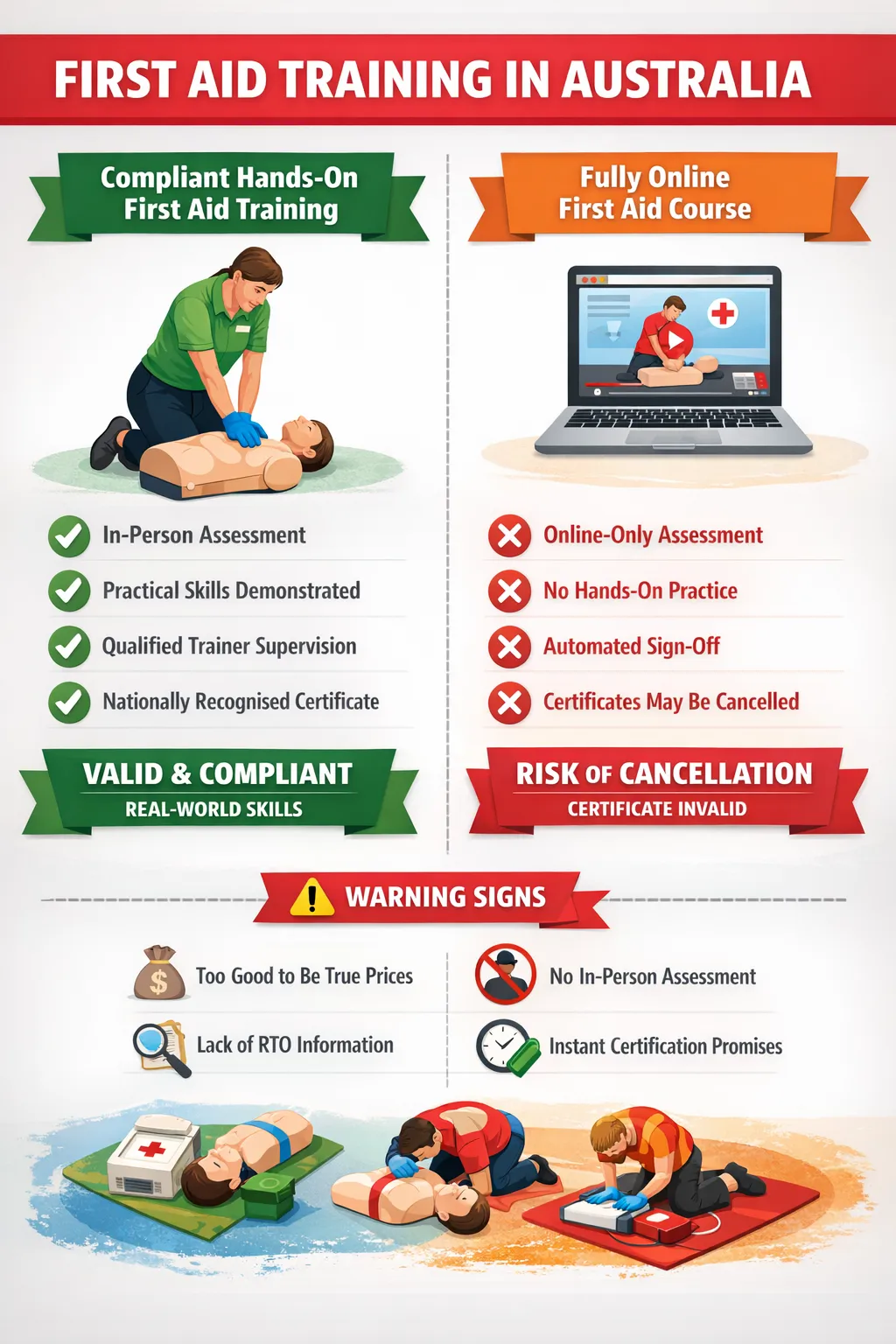
The issue appears when providers advertise fully online certification, including practical sign off.
Some methods used include:
Self-recorded videos
Online quizzes replacing demonstrations
Remote observation through video without proper equipment
Automated sign off systems
These methods may look convenient, but they often fail to meet the strict requirements of nationally recognised training.
When regulators review training records, they look closely at:
Assessment evidence
Trainer supervision
Participant identity verification
Skill demonstration records
If those records do not prove that the required practical assessment occurred correctly, the qualification can be cancelled.
What Happens When Certificates Are Cancelled
This is where things become concerning.
When regulators investigate an RTO and find non-compliant training delivery, several outcomes are possible.
The RTO may be required to:
Reassess all students
Withdraw certificates
Cancel qualifications already issued
Cease delivering certain courses
For people who completed those courses, the consequences can be confusing.
Their certificate may suddenly become invalid.
Sometimes they receive notification.
Sometimes they do not.
They may only discover the issue when:
A workplace audits qualifications
A regulator checks compliance
A job application requires certificate verification
At that point the person must complete the training (and pay) again.
For employers this can create unexpected compliance gaps.
For individuals it can mean wasted time and money.
Why Cheap First Aid and CPR Courses Should Raise Questions
Price alone does not determine quality.
There are excellent training providers who deliver courses at fair and reasonable prices.
However, extremely cheap courses delivered via online meeting platforms often raise compliance questions.
Delivering compliant First Aid training requires real resources and practical scenarios.
Equipment such as:
CPR mannequins
AED training and practice using it in a scenario
Bleeding control practical assessments
Snake Bite first aid kits
Qualified trainers must also supervise practical assessments.
There are venue costs, insurance requirements, and administrative compliance obligations.
If a course price seems impossibly low, it is worth asking why.
Sometimes the answer is simple.
Corners are being cut.
In person, cheap first aid offerings can lead to huge class sizes making it impossible for a trainer to offer any kind of personal assistance
The Compliance Risk for Workplaces
For businesses, the risks extend beyond the individual certificate.
Under Australian workplace safety laws, employers must ensure that:
Workers have appropriate First Aid training
First Aid resources are available
Emergency response capability exists
If a workplace relies on a certificate that later becomes invalid, they may unknowingly fall out of compliance.
This can affect:
Workplace safety audits
Insurance requirements
Contractual obligations
Industry regulatory standards
It also affects the most important factor of all.
The ability to respond when someone is injured.
A certificate alone does not save lives.
Capability does.
A Real Emergency Is Not resolved with a Multiple Choice Quiz
One of the biggest misconceptions about First Aid training is that it is easy.
In reality, emergencies are chaotic.
People panic.
Adrenaline kicks in.
There may be noise, blood, confusion, and multiple people involved.
Even trained professionals rely on repeated practice to stay sharp.
When someone collapses or suffers a serious injury, the brain needs to fall back on trained actions.
That confidence comes fromhands on learning.
Participants need to feel what proper CPR depth feels like.
They need to practise applying pressure to a severe bleed.
They need to work through scenarios with guidance.
Watching a video cannot replace that experience.
When Online Assessment May Be Allowed
It is important to note that there are limited circumstances where remote assessment may be used.
However, these situations are tightly controlled and usually involve:
Remote or isolated environments
Special assessment arrangements
Strict documentation and verification processes
Even then, the training provider must still meet all regulatory requirements.
The problem arises when providers market online practical assessment as a standard option without ensuring that the required conditions are met.
Participants are rarely aware of the risk.
What To Look For Before Booking a First Aid Course
Before enrolling in any First Aid training, it is worth taking a few minutes to check a few key things.
Ask the following questions.
1. Is the course nationally recognised?
Look for course codes such as:
HLTAID009
HLTAID011
HLTAID012
HLTAID013
HLTAID014
These codes indicate nationally recognised units of competency.
2. Who is the Registered Training Organisation?
Even if the training is delivered by a local trainer, the certificate must come from a recognised RTO.
Ask for the RTO number and check that it is legitimate.
3. How are practical skills assessed?
A compliant course should clearly explain:
In person practical assessment
Trainer supervision
Hands on skill demonstration
4. Is there clear documentation?
Legitimate providers will provide information about:
Assessment methods
Course structure
Trainer qualifications
Certificate issuing processes
Transparency is a good sign.
Protect Yourself With a Simple Clause
If you decide to enrol in a course that includes any form of remote practical assessment, consider asking for something in writing.
Specifically, request a clause stating that:
If the certificate becomes invalid due to the online assessment method, an in person practical session will be provided free of charge.
This protects you from having to pay twice if the qualification is later cancelled.
Responsible training providers should have no problem agreeing to this.
If they refuse, that may tell you something important.
Why In Person Training Still Matters
There is a reason in person First Aid training remains the gold standard.
It allows participants to:
Ask questions
Practise repeatedly
Build muscle memory
Work through realistic scenarios
Gain confidence in their ability to act
Good training also creates something else.
Calm under pressure.
When a real emergency occurs, the goal is not just knowledge.
It is the ability to keep your head straight and start helping.
That comes from practice.
The REACHAU Approach to First Aid Training
At Regional Education and Career Help Australia (REACHAU), training is built around a simple idea.
People need to understand what they are doing and why it matters.
Courses are designed to be practical, supportive, and grounded in real world experience.
Training can be delivered:
At your workplace
At a suitable local venue sourced for your group
At scheduled public sessions
The focus is always the same.
Clear learning
Hands on practice
Confidence to act in an emergency
Participants leave knowing they have completed a compliant course and gained real skills.
A Final Word of Advice
Convenience is appealing.
So is a cheap price.
But when it comes to First Aid training, the goal should never be just getting a certificate.
The goal is being ready to help when it matters.
Before enrolling in any course, take a moment to check:
Is it compliant?
Is the practical assessment legitimate?
Will it genuinely prepare you for a real emergency?
Doing that research can save a lot of trouble later.
And it may make the difference between holding a piece of paper and actually being able to help someone in need.
Book Compliant First Aid Training
If you would like more information about compliant First Aid training delivered in Western Australia, or if your workplace would like training delivered onsite, REACHAU can help.
Training is available for individuals, workplaces, community organisations, and industry groups.
Public bookings and contact information can be found at:
You can also send a message to discuss training for your team or location.
Being prepared is not about ticking a box.
It is about having the confidence and capability to step in when someone needs help.
Online vs Compliant First Aid Training

Key Takeaways
Online theory learning can be effective.
Practical First Aid skills must be demonstrated.
Some fully online certificates may not meet compliance standards.
Certificates can be cancelled if training is found to be non compliant.
Always verify the RTO and assessment method before enrolling.
Learn First Aid With Real Skills and Real Confidence
A first aid certificate should represent more than completing an online module.
It should represent the ability to step forward and help when someone is injured, unconscious, or not breathing.
That confidence comes from hands on learning, practical assessment, and training that prepares you for real situations.
REACHAU delivers nationally recognised first aid training designed for workplaces, community groups, and individuals across Western Australia on behalf of ABC First Aid RTO 3399 since 1997.
Training can be delivered:
At your workplace
At a local venue organised for your group
At scheduled public training sessions
Courses available include:
HLTAID009 Provide Cardiopulmonary Resuscitation
HLTAID011 Provide First Aid
HLTAID012 Provide First Aid in an Education and Care Setting
HLTAID013 Provide First Aid in Remote or Isolated Site
HLTAID014 Provide Advanced First Aid
If you want training that is compliant, practical, and built around real world confidence, we are here to help.
Visit https://reachau.com.au to view upcoming courses or contact us to arrange training for your workplace or organisation.
Being prepared is not about ticking a box.
It is about having the knowledge and the confidence to act when someone needs help.