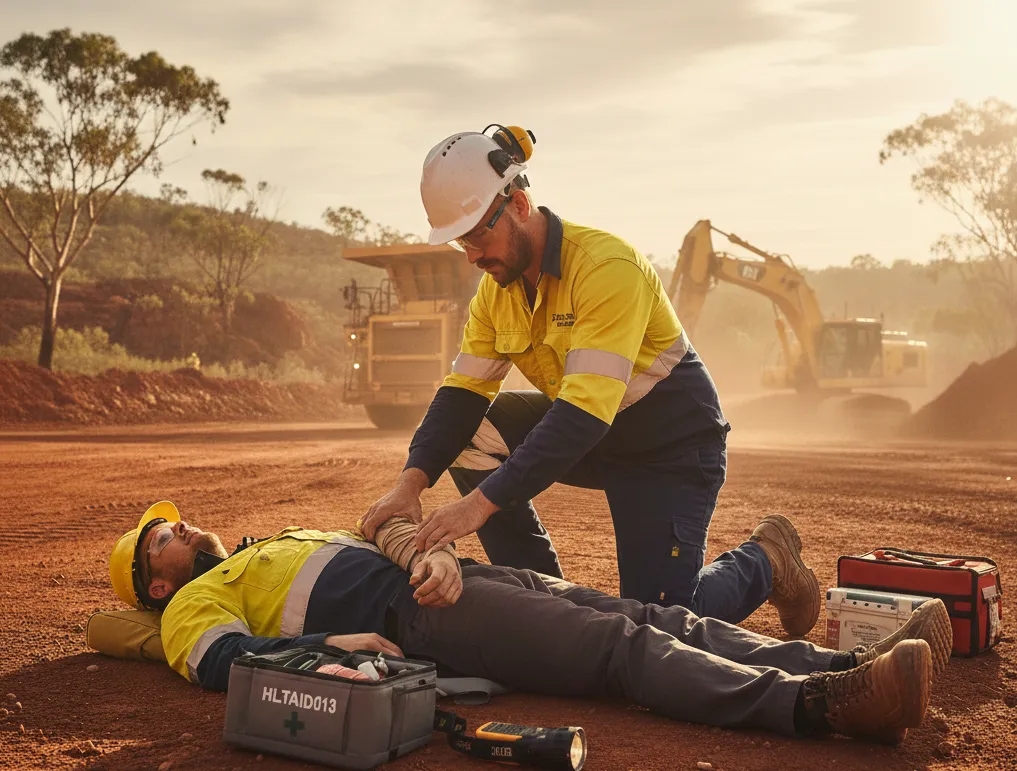
HLTAID013 Remote First Aid for Mining and Resources
Remote First Aid Training for Mining and Resources Workers
When professional help may be hours away, the first person on scene matters most.
By Britt Brennan, REACHAU | Updated 16 October 2026

Why remote first aid matters in mining and resources
Mining and resources operations often take place in some of the most isolated environments in Australia. From the Pilbara and Kimberley in Western Australia to remote exploration sites across the country, workers can be hundreds of kilometres from the nearest hospital.
In these environments, the time between an incident and professional medical care can be much longer than in an urban workplace. Workers may need to manage injuries and medical emergencies for extended periods before evacuation is possible. Remote first aid training helps workers stabilise casualties, monitor their condition and stop injuries becoming life threatening while they wait for medical help.
The changing risk landscape
Modern sites may include electrified vehicle fleets, high-capacity battery systems, autonomous haulage equipment, remote drill operations and extreme environmental conditions. These technologies improve efficiency, but they can also introduce new hazards, such as high voltage electrical injuries, crush injuries from heavy machinery, chemical exposure and severe heat illness. In these situations trained workers may be the only immediate responders available.
What remote first aid training covers
The course is designed for emergencies where evacuation may take hours. HLTAID013 is delivered alongside HLTAID011 Provide First Aid and HLTAID009 Provide Cardiopulmonary Resuscitation. Key skill areas include:
- Extended patient care: monitoring breathing and pulse, recognising signs of deterioration, managing airway and breathing problems, and providing ongoing care until medical help arrives.
- Major trauma: severe bleeding, crush injuries, fractures, burns and head injuries. Modern protocols can include tourniquets and haemostatic dressings for life threatening bleeding. Our HLTAID014 Advanced First Aid page covers more of this.
- Communication: planning around limited mobile coverage, including satellite devices, site radio protocols and clear communication with emergency services.
- Environmental emergencies: recognising heat exhaustion and heatstroke, managing dehydration and cooling a casualty. Heat illness is a common risk in Australian mining regions.
What good remote first aid training should include
When organising training for a resources workforce, look for realistic remote scenarios, including:
- Multiple casualty incidents: vehicle rollovers, blast incidents or machinery accidents can involve more than one injured person, so workers need to understand how to prioritise care using triage principles.
- Snakebite: remote Australia has some of the most venomous snakes in the world. Training should include the pressure immobilisation technique, the recommended first aid for Australian snakebite.
- Looking after each other: remote work can place real pressure on people. Noticing when a colleague is struggling is part of workplace safety. Please note this is a first aid course and not a mental health course.
Practical training builds confidence, hands-on skills, faster decision making and the ability to stay calm during incidents. When workers practise realistic scenarios, they are better prepared to respond in a real emergency.
Remote first aid skills and employability
For many workers entering the FIFO (Fly-In Fly-Out) or DIDO (Drive-In Drive-Out) workforce, a current first aid certificate may be required. HLTAID011 Provide First Aid is commonly requested, and some remote operations also ask for HLTAID013 Remote Area First Aid. Always check the requirements of your employer or site. Workers with these skills can stabilise injured colleagues, support emergency response teams and help reduce risk on remote worksites.
Training with REACHAU
REACHAU provides practical first aid training designed for real Australian conditions, built around the scenarios workers face across Western Australia, including remote worksites, industrial environments and isolated operations. Related courses: HLTAID011 Provide First Aid, HLTAID012 Provide First Aid in an Education and Care Setting, HLTAID013 Provide First Aid in Remote or Isolated Site and HLTAID014 Provide Advanced First Aid. Related reading: CPR and AED basics.
Frequently asked questions
What is remote first aid training?
Remote first aid training prepares workers to manage medical emergencies in isolated locations where professional help may take longer to arrive.
What course covers remote first aid in Australia?
The nationally recognised course is HLTAID013 Provide First Aid in Remote or Isolated Site.
Who needs remote first aid training?
It is useful for workers in industries such as mining, construction, agriculture, tourism and outdoor operations. Check your employer or site requirements.
How is remote first aid different from standard first aid?
It focuses on extended patient care, environmental emergencies and managing casualties until evacuation is possible.
REACHAU first aid training focuses on understanding what to do, why it matters and how to act when someone needs help.
View upcoming first aid sessionsTraining and Assessment is delivered by Britt at Regional Education and Career Help Australia on behalf of ABC First Aid RTO 3399.
This article provides general first aid education. Check the requirements that apply to your own worksite.