
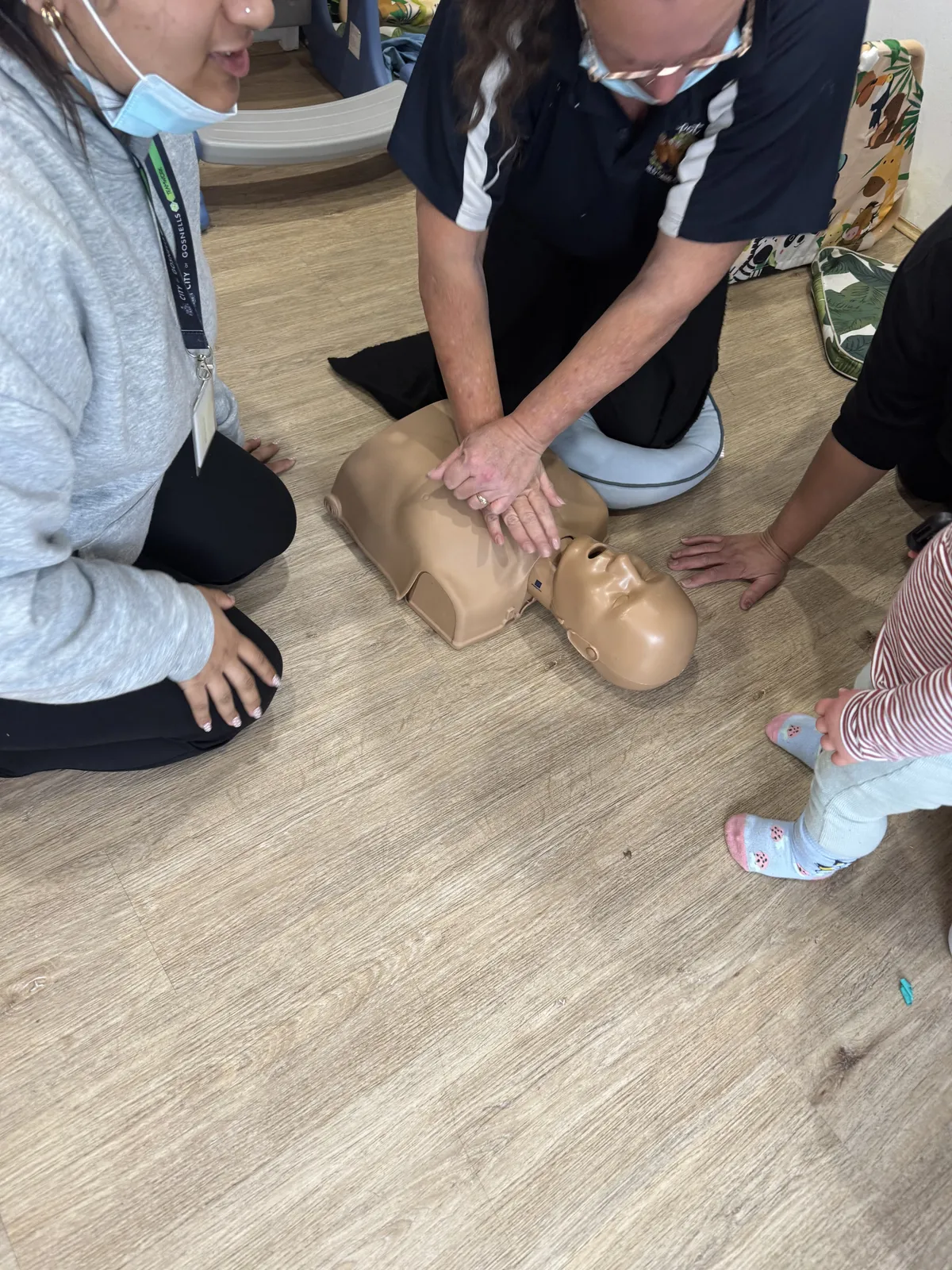
Keep Going: Why CPR Matters Even When We Cannot Know the Outcome
Keep Going: Why CPR Matters Even When We Cannot Know the Outcome
What happens after an out-of-hospital cardiac arrest in Australia, and why the story does not always end when the ambulance arrives.
By Britt Brennan, REACHAU | 19 November 2026
Someone unresponsive and not breathing normally? Call 000, start CPR and send someone for an AED. Turn the AED on and follow its prompts. Keep going until help takes over.

There is a question I ask in my first aid classes that tends to change the conversation.
How long do you think you could keep doing CPR?
Not how long you think a person can survive without their heart beating normally. Not how long you have seen CPR performed on television. How long could you physically maintain effective compressions on another person?
If it were just the two of us, how long could we manage? If I became exhausted, could you take over? How much longer could we continue if another two people arrived? What if we had six people who knew how to perform CPR, somebody bringing the AED and another person speaking to Triple Zero?
Most participants begin thinking about their own limits. They imagine sore shoulders, burning muscles and the difficulty of keeping pace. Then something important happens. They realise that the number of people, how we organise ourselves and how quickly we find an AED can change what is possible.
Then I ask them a different question.
Who gets to decide that enough time has passed?
This article is about that decision, what we are actually trying to achieve when we perform CPR, and a part of the story that doesn't receive nearly enough attention: what can happen after someone is resuscitated and reaches hospital.
Because not every person whose heart starts beating again will walk out of hospital. Some people need intensive care. Some have suffered irreversible injuries. Some families face decisions they never imagined making. In a small number of cases, organ donation becomes possible after death.
That does not make CPR a way of obtaining organs for donation. It makes CPR what it has always been: an emergency effort to give a person their best possible chance, with no promise about how the story will end.
The moment everything changes
Imagine arriving at a community event, a workplace or a family gathering and finding someone collapsed on the ground.
They are not responding. They are not breathing normally. Perhaps they are making an occasional gasping sound that looks like a breath but is not normal breathing.
You have a decision to make.
You can spend the next few minutes trying to convince yourself that the person is not really in cardiac arrest. You can stand back because somebody else appears more confident. You can worry that you might hurt them. Or you can recognise the emergency, send for help and start acting.
In Australia, our basic life support sequence is DRSABCD: Danger, Response, Send for help, Airway, Breathing, CPR and Defibrillation. ANZCOR advises that if someone is unresponsive and not breathing normally, rescuers should begin CPR. An AED should be attached as soon as one becomes available, and its prompts followed.
We teach this sequence for a reason. It helps people do the important things when stress is interrupting their thinking.
But remembering letters is only the start. Understanding why each action matters is what makes the training useful when real life doesn't look like the practice scenario.
What CPR does, and what it doesn't do
A cardiac arrest means the heart is no longer pumping blood effectively enough to sustain life. Blood flow to the brain and other vital organs is critically affected.
CPR is an attempt to generate circulation by physically compressing the chest. Rescue breaths can provide oxygen, while compressions help move oxygenated blood. It is not the same as restoring a normal heartbeat, and it does not repair every cause of an arrest.
Think about that distinction.
When I say we are buying time, I do not mean that every extra minute of CPR guarantees another minute of useful brain function. The blood flow CPR generates is limited, and its quality varies. Delays in recognising the arrest, delays in starting compressions, the cause of the arrest, the person's underlying health and many parts of professional treatment all influence the outcome.
What I mean is that effective CPR can preserve an opportunity for an AED and advanced medical treatment to work. Without that action, the opportunity may disappear much sooner.
An AED is not a machine that restarts every stopped heart. It assesses the heart rhythm and, when appropriate, delivers a shock to interrupt a shockable rhythm. For other rhythms it will not advise a shock. Follow the machine's instructions and continue CPR when directed.
The AED is important precisely because CPR and defibrillation have different jobs. They work together, not as alternatives.
Why more people matter
When people first think about giving CPR, they often picture one rescuer kneeling on the floor, working until an ambulance arrives.
Sometimes that is the reality. Sometimes one person is all that is available.
But wherever more helpers are present, we can use them.
- One person calls 000 and gives the precise location.
- Another finds the AED.
- Another starts compressions.
- Others take turns, bring equipment or guide emergency services to the patient.
Chest compressions are physically demanding. Even somebody who is fit can tire quickly. The problem is not simply that the rescuer becomes uncomfortable. As fatigue sets in, compression depth, rhythm and recoil can deteriorate.
That is why competent rescuers share the work. ANZCOR recommends that, where feasible, rescuers change over at least every two minutes to prevent fatigue and a drop in compression quality, keeping interruptions to a minimum.
There is no medal for being the only person who does the compressions.
The goal is not to prove you can work harder than anyone else. The goal is to give the casualty the best CPR the available team can provide.
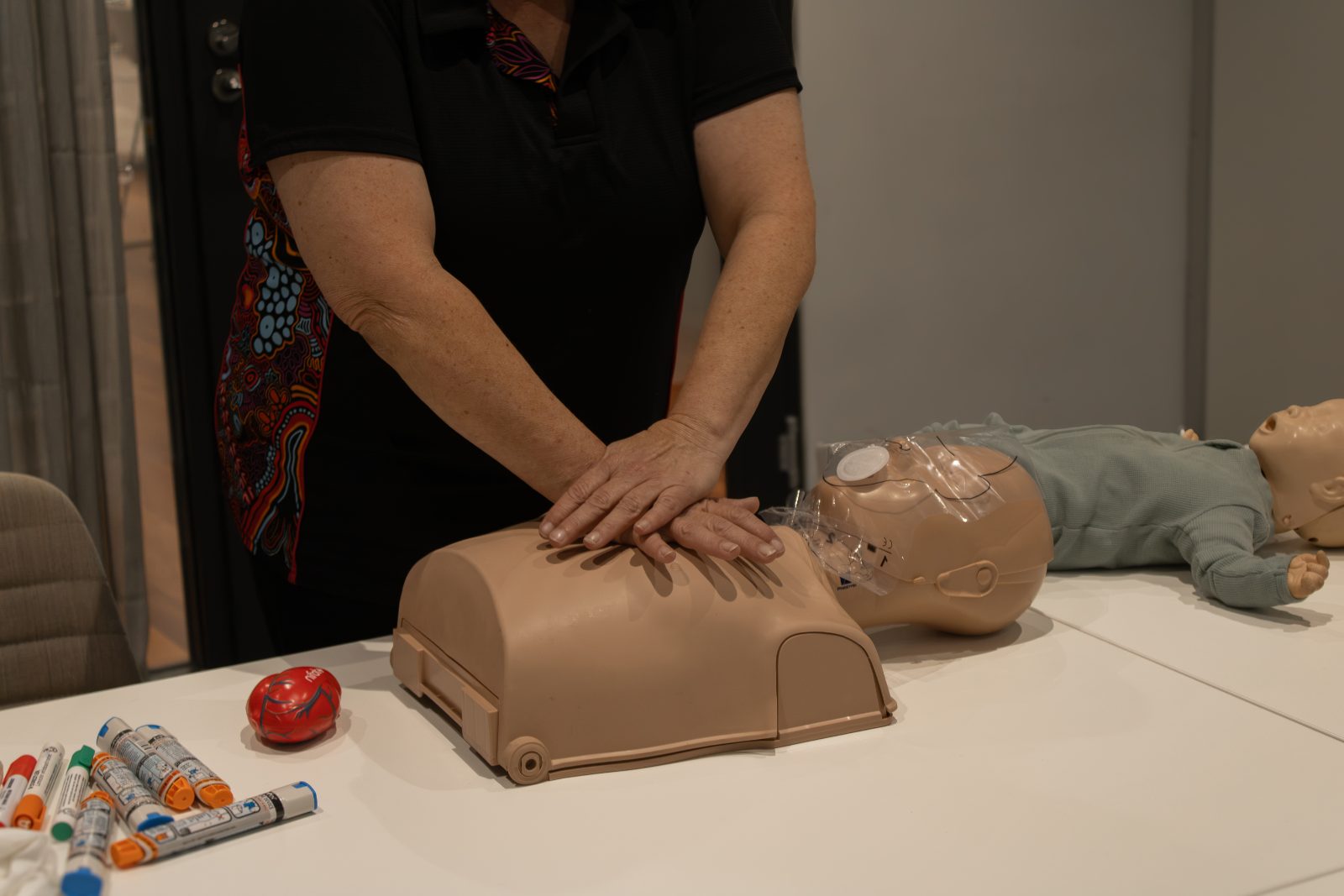
In a remote location, the challenge becomes even greater. An ambulance may be much further away. The person giving instructions over the phone may be the only immediate professional support. That is why I put so much emphasis not only on the physical skills but also on organising the scene, communicating clearly and searching early for an AED.
The first aider doesn't need to know how the story will end. They need to know what to do next.
What the Western Australian numbers tell us
St John WA's 2024 out-of-hospital cardiac arrest report describes 1,240 cases where St John WA attempted resuscitation, including 1,193 adults and 47 children.
The report recorded 133 people surviving to 30 days, about 11% of those attempted resuscitations. It also reported that 23% had a pulse on arrival at hospital. The two measures are different. Reaching hospital with circulation is an important step, but it is not the same as surviving to leave hospital or returning to everyday life.
The report also compared 30-day survival for people who did and did not receive bystander CPR. These comparisons use different groups from the 1,240 figure above, so they should not be lined up against the 11%.
| Group (St John WA, 2024) | With bystander CPR | Without bystander CPR |
|---|---|---|
| Arrests not witnessed by paramedics | 9.2% | 5.7% |
| Arrests witnessed by a bystander | 16.3% | 11.7% |
We have to read those figures carefully. They describe different groups of patients. They cannot prove that CPR alone caused every difference, or tell us that an individual casualty has a particular chance of survival.
But the figures support the very practical lesson I teach: an early response matters, and the time before paramedics arrive is not wasted time.
The report also recorded 66 people receiving a shock from a community AED, with 31 surviving to 30 days. That is a striking finding, although it comes from a relatively small and selected group.
If you remember one thing from these figures, make it this.
When a cardiac arrest happens in front of you, you are not standing around waiting for the medical response to begin. You are part of that response.
When should a first aider stop CPR?
This is one of the most important parts of the discussion.
There is no simple clock on the wall that tells a public first aider that after ten, fifteen or twenty minutes they should stop because the situation is hopeless.
ANZCOR Guideline 8 says to continue CPR until one of these happens:
- The person responds or begins breathing normally.
- It becomes impossible for you to continue, for example through exhaustion.
- A health care professional arrives and takes over.
- A health care professional directs that CPR stop.
Safety still comes first. If the scene becomes dangerous, you must not ignore that danger.
That is different from deciding that a person has probably been down too long, or that they look too old or too unwell to survive.
We do not have enough information to make those assumptions.
And that, to me, is part of why first aid education has to cover more than the sequence of compressions and breaths. We need to explore the very human reasons people hesitate or stop. Fear. Fatigue. Embarrassment. Pressure from other bystanders. Someone saying the ambulance has taken too long.
Those are real challenges. They deserve to be discussed openly in a classroom.
The answer is not to pretend that everyone can perform perfect CPR for an hour. It is to help people prepare: call early, get the AED, recruit help, swap compressors when possible, and listen to the emergency call-taker.
Continuing CPR isn't a promise of survival. It is a decision to keep providing appropriate care while there is a reason and an ability to do so.
What if someone says the person has a DNR?
This question deserves careful treatment, because people hear the term Do Not Resuscitate and may think it is a simple instruction that anyone at a scene can automatically apply.
It isn't always that straightforward.
The terms DNR, DNAR and Not for Resuscitation are commonly used, but there are different types of medical orders and advance care planning documents. How they apply depends on the person's circumstances and the relevant law and clinical guidance.
As public first aiders, we usually have no straightforward way to check whether a document exists, whether it is current, whether it applies to the emergency in front of us, or whether the person telling us about it has understood it correctly.
My advice is not to turn that uncertainty into a confrontation with a distressed family member.
- Don't get into an argument.
- Call Triple Zero (000) immediately.
- Explain that the person is unresponsive and not breathing normally.
- Explain who has said a DNR exists, what you have been told and whether any documentation is available.
- Follow the call-taker's guidance.
If it is safe and appropriate to start or continue CPR, follow that direction. If a valid and applicable refusal of resuscitation is established, it must be respected.
A conscious person who can make and communicate their own decision to refuse help is a different situation from an unresponsive person whose family member is reporting a DNR. Do not confuse the two.
In Western Australia, an Advance Health Directive can contain decisions about life-sustaining treatment and resuscitation. It applies when the person cannot make or communicate the relevant treatment decision and the directive actually covers the treatment needed. WA Health also recognises that emergency treatment may sometimes be provided when it is not practicable to find out whether an applicable directive exists or to get an authorised decision.
Paramedics may be able to clarify documentation and the person's wishes at the scene. In other circumstances, further assessment may happen at hospital. We should not promise that resuscitation will always continue until the person reaches an emergency department, or that clinicians cannot appropriately decide to withhold treatment at the scene.
Our message for public first aiders is simpler.
Do the best you can with the situation in front of you. Do not make unsupported assumptions. Respect known wishes. When you are unsure, 000 can help you through the immediate decision.
What happens when the ambulance arrives?
The ambulance team can assess much more than a first aider can.
They can identify heart rhythms, deliver advanced resuscitation treatments, look for possible causes and decide on the next steps. Their decisions are guided by clinical protocols, the circumstances of the arrest and how the patient responds.
Sometimes resuscitation is successful enough for a pulse to return. Clinicians call this return of spontaneous circulation, or ROSC.
A pulse returning is good news, but it doesn't mean everything is suddenly fine. The brain, heart and other organs may have gone without normal circulation. The cause of the arrest may still need urgent treatment. The person may remain unconscious and need help with breathing, medications to support circulation and intensive monitoring.
Some people make an excellent recovery. Some live with long-term disability. Others deteriorate or never regain consciousness. Some die despite treatment.
The first aider does not get to choose which pathway the person takes. Neither does a family member. That is why it can be misleading to say the person was saved at the scene. A better way to describe the immediate outcome may be that circulation was restored and the person was transferred for further treatment.
The hospital journey has only just begun.
The part of the story we don't talk about enough
When people hear the phrase successful resuscitation, they may imagine a person waking up, speaking to their family and eventually leaving hospital.
That is one possibility, and of course it is the outcome we hope for.
But what if circulation is restored and the person's brain has already been severely injured?
What if the person needs a ventilator and intensive care but cannot recover?
What if, despite all the treatment available, the medical team finds that continued life support cannot change the outcome?
The family may be pulled into a world of medical terminology, uncertainty and decisions they never expected to face.
There may be opportunities to sit beside the person, hold their hand, speak to them, spend time together and ask questions of the team caring for them.
I want to be careful here. Reaching hospital does not guarantee that someone will live long enough for their family to arrive. It doesn't guarantee conscious interaction or meaningful time together. And continuing treatment purely to create a goodbye is not automatically in a patient's interests.
Yet for some families, the hospital period creates the opportunity to understand what happened, hear the medical explanation and be involved in what happens next.
That can be an important part of the story even where survival is not possible.
DonateLife and ANZICS guidance on death and organ donation recognises that families may value time together, privacy, clear communication and appropriate support before and after death.
Those moments are personal. They cannot be reduced to a survival statistic.
An Australian study linking cardiac arrest, hospital death and donation
Research published in Resuscitation Plus in 2022 gives an important Australian insight into this journey.
Melanie Wittwer and colleagues examined adult non-traumatic out-of-hospital cardiac arrests treated within the Northern Adelaide Local Health Network between 2011 and 2016, focusing on patients who died after reaching hospital.
Among 69 deaths in the emergency department with mode-of-death information, cardiovascular instability was the main mode of death in 75%.
Among 144 patients who died after admission and had mode-of-death information, the picture was different. About 72% died through pathways related to neurological injury: 47% after withdrawal of life-sustaining treatment for neurological reasons and 24% after formal brain death (the combined figure reflects rounding).
The group who progressed to brain death had the highest rates of organ donation.
These figures are sobering. They also need to be understood properly.
The study is not telling us that 72% of all people who have a cardiac arrest end up with brain injury, or that 24% of cardiac arrests lead to brain death. Its participants were a selected group of people who reached hospital and later died.
It does not tell us how many extra donors come from an additional five or ten minutes of bystander CPR. It does not show that longer CPR produces more organ donations.
What it does show is that in the Australian hospital experience after out-of-hospital cardiac arrest, neurological injury, end-of-life care and possible organ donation are connected realities.
This is a part of the journey that deserves to be discussed without pretending it is the most likely outcome.
What organ donation actually involves in Australia
Australia has strict clinical and legal processes for deceased organ donation.
Most people who die cannot become organ donors. Organs need to remain suitable for transplantation, and the circumstances of death matter.
DonateLife reports that only around 2% of people who die in Australian hospitals can be considered for deceased organ donation.
| Australia, 2025 (DonateLife) | Figure |
|---|---|
| Hospital deaths | about 89,000 |
| Deaths where donation could be considered | about 1,670 |
| Families approached | about 1,500 |
| Family consents | 790 |
| Deceased organ donors | 557 |
| Transplant recipients | 1,438 |
| Western Australia: donors and recipients | 61 donors, 165 recipients |
These are national and state donation figures from all eligible causes, not figures limited to cardiac arrest. We cannot join them to ambulance cardiac arrest statistics and call the result an organ donation conversion rate.
And we should not.
This subject matters enough to be accurate.
Brain death and circulatory death are not the same thing
There are two main pathways for deceased organ donation.
Donation after brain death happens when death has been determined through the permanent loss of all brain function, following the required clinical process. The heart may still be beating because ventilation and other treatment are supporting circulation, but the person has died. The medical team can then discuss donation with the family and, with the required support and consent, maintain organ function until donation arrangements are complete.
Donation after circulatory death involves a different clinical pathway. In the usual controlled hospital setting, a patient with devastating illness or injury is being supported by life-sustaining treatment. After an independent decision that continued treatment is no longer of benefit and will be withdrawn, donation may be considered. If death occurs within the required timeframe and all other criteria are met, organ donation may be possible.
The decision to withdraw life-sustaining treatment must be independent of any decision about donation.
That point is essential.
No one should leave this article thinking clinicians stop treating patients in order to obtain organs, or that someone receiving CPR is considered a donor before their own care has been properly addressed.
A person's life, wishes and appropriate care come first. Donation is a separate process that may become possible after death.
It is also worth separating organ donation from eye and tissue donation. Eye and some tissue donation may be possible after a death outside hospital in circumstances where organ donation is not. Families can get advice from the relevant donation services.
Can a person who has a cardiac arrest become an organ donor?
Yes, in some circumstances.
For example, someone might have a cardiac arrest, receive bystander CPR, have circulation restored and be treated in intensive care. They may later die after a catastrophic brain injury, and clinicians may identify that they could be eligible for organ donation.
That is possible. It is not predictable at the scene. It is not common enough to be described as the expected outcome. Nor is it the reason to do CPR.
A public first aider cannot determine whether a person is suitable for donation. There is no way to work out an individual's possible donation outcome from how long CPR has been given.
The correct connection is one of possibility, not certainty.
Effective first aid can help keep a person on a pathway where professional care remains possible. Later, if the person dies despite that care, donation may be assessed in some cases.
That is a carefully limited statement, and it is the one worth teaching.
Why I would never tell a first aider to keep going just for organ donation
Imagine the pressure we would place on people if we told them that giving up meant denying someone else a transplant.
That would be unfair and medically wrong.
People already carry guilt after an unsuccessful resuscitation. They wonder whether they started too slowly, pushed hard enough or made the wrong decision.
We do not need to add the idea that they might also have cost another family an organ.
The purpose of CPR is to try to preserve the casualty's life. The right reason to continue is the emergency care needed by the person in front of you, within the limits of safety, physical ability and guidance.
Organ donation is a possible later outcome in selected cases. It should never become a burden placed on the first aider.
This is one reason I want to discuss both subjects together. We can recognise the remarkable difference organ donation makes to recipients and their families without turning CPR into a promise or a source of guilt.
Whose decision is it to donate?
In Australia, families play a central role in deceased organ donation.
You can record your decision on the Australian Organ Donor Register, and you should tell your family what you want. DonateLife explains that families are asked to support donation, even where a person has registered a decision.
Why is that conversation so important?
Because an organ donation discussion can happen at a time when a family is exhausted, frightened and grieving. They may be trying to understand how someone who was apparently well that morning is now dying in an intensive care unit.
Knowing what the person wanted can make the conversation clearer.
Just as importantly, organ donation must remain a choice that is approached respectfully. Families deserve factual explanations and compassionate support, not persuasion through guilt.
A family that does not proceed with donation has still experienced a profound loss. Their decision does not diminish that loss or the dignity of the person who died.
The other side of organ donation
When we talk about organ donation, we often start with the people who donate. Sometimes we forget there is another family whose life may be transformed by the transplant.
There are children, parents, partners and grandparents in Australia living with serious organ failure. Some are waiting for a transplant. Some have already received one.
That is why the 2025 Australian figures matter: 1,438 Australians received transplants thanks to deceased donors.
But each number represents a person and the people who love them.
A transplant can mean ongoing medication, follow-up appointments, medical uncertainty and many adjustments. It can also open up new possibilities for daily life and family experiences.
Recipients and their families are not just the happy ending to somebody else's tragedy. Their stories have their own complexity, responsibility, gratitude and challenges.
I hope to explore that side of the subject in a future conversation with a Western Australian family who has personal experience of paediatric organ transplantation.
For now, their story remains theirs to tell, in their own words and only with their permission.
The question I ask my students again
Let's go back to that classroom question.
You are kneeling beside someone who has collapsed. CPR has been going for several minutes. Your shoulders are hurting. The ambulance has not arrived. Somebody in the crowd says it has been too long.
What do you do?
You don't have to pretend you're not tired. You don't have to be superhuman. If other capable rescuers are available, change over while keeping interruptions as short as possible. If you are alone, continue as effectively as you can. If exhaustion makes it impossible, that is a real limit, not a moral failure.
Keep listening to 000. Follow the AED prompts. Watch for normal breathing or a response. Hand over clearly when the ambulance arrives.
And don't let someone else's guess about the outcome become your medical decision.
Now imagine there are four rescuers, all trained, and an AED has arrived.
Can you organise yourselves differently? Can the team keep up better-quality compressions? Can one person look after the AED while another speaks to the call-taker? Can you change over before everybody is exhausted?
Those are valuable questions because they turn spectators into people who understand their role.
I don't want participants leaving my courses thinking they must be fearless. I want them to understand enough to act even when they are frightened.
What if the person doesn't survive?
This is the conversation that has to sit beside any strong message about continuing CPR.
Sometimes the person dies.
Sometimes they are too far into the arrest for treatment to succeed. Sometimes their underlying illness or injury cannot be reversed. Sometimes resuscitation brings circulation back for a time, but the person later dies in hospital.
That does not automatically mean the first aider performed badly.
The right actions improve a person's chance, but no training organisation should promise that those actions will always save a life.
A person who has attempted resuscitation may also need support afterwards. They might feel shaken, angry, numb or distressed. They may keep replaying what happened, especially if they knew the casualty.
Those reactions deserve to be taken seriously. Talking it through with someone you trust, your GP or your workplace support program is a sensible step.
First aid education should help participants understand how to seek support after a difficult event, not just how to wipe down the training manikin and leave the room.
And when we discuss family time, end-of-life care or organ donation, we must do it sensitively. There is no obligation on a family to see their loss as meaningful because donation was possible, or because some time at hospital was available.
We can acknowledge an opportunity without romanticising the tragedy.
What to do: the short version
- Check for danger and keep yourself safe.
- Recognise the emergency: unresponsive and not breathing normally (gasping is not normal breathing).
- Call 000 or get someone else to, and give the exact location.
- Start CPR straight away.
- Send for an AED, turn it on and follow its prompts.
- Share the work: if others can help, swap compressors at least every two minutes.
- Keep going until the person responds or breathes normally, you physically cannot continue, or a health professional takes over or tells you to stop.
- If a DNR is raised, don't argue. Tell 000 what you have been told and follow their guidance.
- Look after yourself afterwards. Talk to someone about what happened.
What should we take away from all this?
I want Australians to understand three things.
First, early CPR and an AED matter. They can improve the chance that someone survives a cardiac arrest. You do not need to know every possible cause of the arrest before taking action.
Second, it is not your job as a public first aider to decide a person is beyond help because a certain number of minutes has passed. You follow recognised guidance, work within your ability, protect your own safety, get help, and use 000 when you are unsure. If a DNR is raised, do not assume or argue. Explain the circumstances and seek guidance, while respecting established treatment refusals.
Third, we need a more complete understanding of what happens after CPR. Some people survive and recover. Some need extensive hospital treatment. Some do not survive, but their families may have time with them, receive explanations and take part in end-of-life care. A small number may be eligible for organ donation after death.
Those outcomes are not interchangeable. They cannot be guaranteed. They do not justify treatment that is not in the person's interests.
But they help explain why we should not decide the ending before qualified help has had the chance to assess and treat the person.
The next time someone asks why I want people to keep doing CPR when the ambulance hasn't arrived, my answer will stay simple.
Because we don't know the outcome.
We do know what our responsibility is.
Recognise the emergency. Call for help. Start CPR. Get the AED. Work as a team where possible. Continue within the guidance and your physical limits. Give the person in front of you the best chance you can.
You are not responsible for controlling the ending.
You are responsible for doing the best you can with the part of the story that has been placed in your hands.
Frequently asked questions
How long should you keep doing CPR?
Keep going until the person responds or starts breathing normally, it becomes impossible to continue, or a health professional takes over or tells you to stop. There is no set time limit for a first aider.
How often should rescuers swap during CPR?
ANZCOR recommends changing over at least every two minutes where feasible, with as little interruption to compressions as you can manage. Fatigue reduces compression quality, even in fit people.
Does bystander CPR make a difference in Western Australia?
St John WA's 2024 report showed higher observed 30-day survival among people who received bystander CPR than among those who did not. The figures describe groups, not individuals, but they support starting CPR early.
What should I do if someone says the person has a DNR?
Don't argue. Call 000, explain what you have been told and whether any paperwork is available, and follow the call-taker's guidance. A valid and applicable refusal of resuscitation must be respected.
Does a pulse coming back mean the person will survive?
Not necessarily. Return of circulation is an important step, but many people still need intensive care, and outcomes range from full recovery to death in hospital.
Can someone who had a cardiac arrest become an organ donor?
In some cases, yes, if they later die in hospital in circumstances where donation can be considered. It cannot be predicted at the scene and it is never the reason to do CPR.
Who decides about organ donation in Australia?
Families are asked to support donation, even when the person is on the Australian Organ Donor Register. Registering and telling your family what you want makes that conversation clearer.
What if I gave CPR and the person died?
That does not mean you did it wrong. CPR improves a person's chance but cannot guarantee survival. It is normal to feel shaken afterwards, so talk to someone you trust or your GP.
REACHAU first aid training is practical and scenario based, including team CPR and AED use, so you understand what to do, why it matters and how to act under pressure. Start with HLTAID009 CPR or HLTAID011 Provide First Aid.
View upcoming first aid sessionsTraining and Assessment is delivered by Britt at Regional Education and Career Help Australia on behalf of ABC First Aid RTO 3399.
Sources and further information
ANZCOR Guideline 8: Cardiopulmonary Resuscitation (CPR)
ANZCOR Guideline 6: Compressions
ANZCOR Guidance Statement 10.5.3: Legal and Ethical Issues Related to Resuscitation
St John WA: 2024 Out-of-Hospital Cardiac Arrest Report (published October 2025)
Wittwer MR et al. In-hospital mode of death after out-of-hospital cardiac arrest. Resuscitation Plus, 2022
DonateLife: Australian donation and transplantation data
DonateLife: Talk to your family about donation
HealthyWA: Advance Health Directives
WA Health: Advance care planning FAQs
This article is general first aid education based on Australian guidance and published data available in November 2026. It is not individual medical or legal advice and does not replace a first aid course. In an emergency, call 000 and follow the instructions you are given.