A Baby Seat Is Not Water Supervision: Infant Water Safety
A Baby Seat Is Not Water Supervision: Infant Water Safety
Why supervision, prevention and infant CPR belong in the same conversation, with care and without blame.
By Britt Brennan, REACHAU | 21 November 2026
Have you noticed how quickly a family routine becomes something we do without thinking?
We put the washing on, answer the phone or reach for a towel, often while caring for a baby. Most of the time nothing goes wrong, so the routine starts to feel safe.
Water is one place where that feeling can let us down. This article is not here to frighten parents or to judge anyone. It is here to give you information you can use today.
What can we learn from this WA finding?
What the finding says
In 2016 the Coroner's Court of Western Australia delivered a finding about a young child referred to as TPL (a child). The child's name and identifying details are suppressed by the court, and I respect that fully. The finding looked at an incident involving water and a seat that was not designed for use in water. The court made no formal recommendations and emphasised vigilance around water.
That is all we need from the record. Behind it is a family who lost a child, and I hold that in mind in everything that follows.
A coronial finding is a legal account of a tragedy. It is not an invitation to judge a family with the benefit of hindsight, and I will not do that here.
The question I take from it is one every household can ask. What are we relying on to keep a baby safe around water? An adult who is watching, or a product and a routine?
Everything from here is my own teaching suggestion. It is not a finding of the coroner.
A five minute water safety check
Picture Jo, a fictional grandparent who minds a baby two days a week. Before the next visit, Jo walks through the house with this list. You can do the same. Tick each one as you go.
Why are babies so vulnerable around water?
A baby does not have the strength or coordination to lift their face clear or to move away. They also cannot tell you something is wrong.
Here is the why. When the nose and mouth are under water, a person cannot breathe. The body runs on oxygen, and the brain is very sensitive to going without it.
Drowning is also not reliably noisy. Do not count on splashing or crying to alert you from the next room. That is why the plan has to be supervision, not listening out.
Is a baby seat or bath support a safety device?
No. Seats, rockers and bath supports each have a purpose, and that purpose has limits.
- Read the instructions. Do not guess from how the product looks.
- Check the age and size limits, and where it can and cannot be used.
- If the label says not for use in water, treat that as a firm rule.
- Make sure everyone who uses it knows the limits, including grandparents and babysitters.
Even a product made for bathing does not replace you. It helps with holding. It cannot notice a change and it cannot call for help.
What does active supervision look like?
Supervision is a task, not a feeling that plenty of adults are around.
At a family barbecue there might be ten adults near a pool. It is still possible for every one of them to assume somebody else is watching.
So make it specific. Name the person who is watching. If they need to leave, they hand over properly. "Can you watch the kids at the pool while I go inside?" Then wait for a clear yes.
Rethink "only a second"
Phones ring. Someone knocks. Another child calls out. Plan for the interruption before it happens. If you must step away, the baby comes out of the water and goes with you.
What should I do if a child is taken from water and is not responding?
ANZCOR guidance for drowning is:
- Attempt a rescue only if it is safe for you. At home, lift the child from the water straight away.
- Lay them on their back and check for a response and normal breathing.
- Call 000, or have someone else call. Put the phone on speaker.
- If they are unresponsive and not breathing normally, start CPR and include rescue breaths.
- Do not wait for an AED or any other equipment before you start.
Anyone who has been pulled from water and needed help should be checked by medical professionals, even if they seem to recover.
If you are unsure what to do, the 000 call taker will talk you through it. Uncertainty is not a reason to hold back.
Why do rescue breaths matter so much after drowning?
I spend time on the why in class because it changes how people use the skill.
Chest compressions move blood around the body. Rescue breaths put air into the lungs. After drowning, lack of oxygen is at the centre of the problem, so breaths matter a great deal.
ANZCOR guidance for community rescuers is 30 compressions to 2 breaths, with the technique adapted for the person's age.
How is infant CPR different, and how do I learn it?
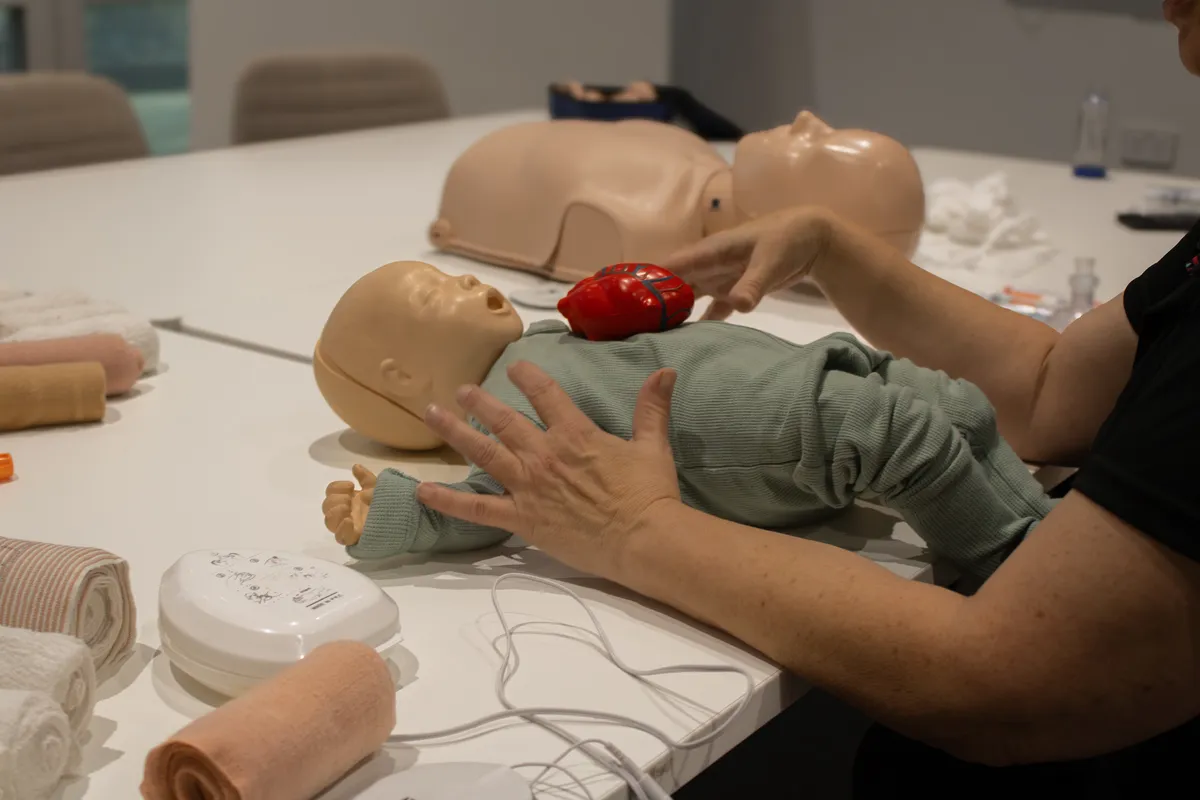
A baby is not a small adult. The airway position is gentler and the compression technique is adapted for their size.
This is very hard to learn from a paragraph or a picture. Hands on practice lets you feel it, ask questions and be corrected until it makes sense.
The best time to find out you are unsure is in a training room, not while you are waiting for an ambulance.
How do I bring grandparents and other carers into the plan?
Many babies are cared for by grandparents, relatives and friends. They may be loving and experienced, and still not know a particular product or the layout of your home.
- Show them where each piece of baby equipment is used, and where it must not be used.
- Point out the water a child could reach.
- Agree on how you hand over supervision when more than one adult is home.
- Make sure they have the address and know to call 000.
If you are the grandparent or visiting carer, ask. "I have not used this before. Show me how it works and where it is safe." That is a responsible question.
A family does not need to live in fear of the worst case to be safer. It needs a few good habits and the confidence to act. That is what I want you to take from this.
Frequently asked questions
Can I use a baby seat or bath seat to keep my baby safe in water?
No. A seat or support can help you hold or position a baby, but it is not a safety device and it cannot supervise. Use products only the way the instructions say, and stay within arm's reach with your full attention.
What does active supervision of a baby around water mean?
It means an adult is within arm's reach, watching the child and not doing another task. If that adult needs to step away, the baby comes out of the water with them, or another adult clearly agrees to take over.
What should I do if a baby is taken out of water and is not responding?
Call 000. If the baby is unresponsive and not breathing normally, start CPR and include rescue breaths. Put the phone on speaker so the call taker can guide you. Do not wait for equipment.
Why are rescue breaths so important after drowning?
In drowning, the main problem is a lack of oxygen. Rescue breaths put air into the lungs while compressions move blood around the body. ANZCOR guidance specifically says to include rescue breaths in CPR after drowning.
Is infant CPR different from adult CPR?
Yes. A baby's head, neck and chest are different, so the airway position and the compression technique are adapted for their size. It is best learned hands on, with an infant manikin and a trainer who can correct you.
Which first aid course covers infant and child CPR?
HLTAID012 Provide First Aid in an education and care setting includes infant and child first aid and CPR. It suits parents, grandparents, carers and childcare educators.
Does learning CPR make it safe to step away for a moment?
No. CPR is an emergency skill. Supervision is prevention. They are two different jobs and a family needs both.
Sources and current guidance
- Coronial finding: Inquest into the death of TPL (a child), subject to a suppression order, Coroner's Court of Western Australia
- ANZCOR Guideline 9.3.2, Resuscitation in Drowning
- ANZCOR Guideline 8, Cardiopulmonary Resuscitation (CPR)
REACHAU first aid training focuses on understanding what to do, why it matters and how to act when someone needs help.
View upcoming first aid sessionsTraining and Assessment is delivered by Britt at Regional Education and Career Help Australia on behalf of ABC First Aid RTO 3399.
Related reading
- DRSABCD: the first aid action plan
- Emergency phone access in childcare: why supervision and a plan come first
- Childcare first aid: connecting plans, people and practice
- After the emergency: looking after yourself when you helped
This article shares general learning points from a published coronial finding and current ANZCOR guidance. The child's identity is protected by a court order and is not used here. The examples are fictional and do not reconstruct the incident. This is general education. It does not replace hands-on training, medical advice or current childcare and pool safety requirements. In an emergency, call 000.