
Choking Prevention in Aged Care Starts Before the Emergency
Choking Prevention in Aged Care Starts Before the Emergency
What a New South Wales coronial finding teaches us about preventing choking, speaking the same language and recognising an emergency quickly.
By Britt Brennan, REACHAU | 6 November 2026

Every person who works in aged care knows that mealtimes are important. They are also a moment of real risk for some residents, especially those who have difficulty swallowing.
In February 2026, a New South Wales coroner delivered findings on the deaths of two residents of the same aged care home, nine months apart. Both died after food blocked their airways. The finding is long and detailed. This article draws out the parts that matter most to first aiders, carers and families, and does it with respect for the two people and for those who cared for them.
What the coroner found
What the finding says
The Deputy State Coroner delivered the findings on 27 February 2026 in the Coroner's Court of NSW, Lidcombe. Dimosthenis Gesios died in June 2019 and Maureen McGreevy died in March 2020. Both were residents of the same aged care home and were on a minced and moist diet. The coroner found that both died from choking, when a food bolus blocked the airways.
For Mr Gesios, the coroner concluded that he was not fed appropriately that morning. It was likely that he was given too large a mouthful, or more than one mouthful without a chance to swallow, and the carer did not promptly seek help or convey urgency. A nurse used suction and an ambulance was called. Because Mr Gesios had a do not resuscitate order, no resuscitation was started.
For Ms McGreevy, a different tray was delivered to her room than the one that had been prepared for her, for reasons that are unknown. She ate bread in her room, and later a staff member saw her gasping and saying she could not breathe. Paramedics found a complete blockage and started resuscitation, but she could not be revived.
The coroner noted that the home has since strengthened its processes, including annual training on choking and swallowing standards, a feeding competency assessment and a first aid policy for choking. The home was later closed by its operator.
The coroner made recommendations to two national bodies. The first set was to the Aged Care Quality and Safety Commission, to consider developing consistent minimum training expectations for kitchen and nursing staff on identifying and managing choking risk, and to consider a way for providers to assess and document the competency of nursing staff. The second was to the board of the International Dysphagia Diet Standardisation Initiative, asking it to consider whether gelled bread should remain a permitted food in a minced and moist diet, or be better defined. These use the word consider.
Anything else in this article is my teaching suggestion. It is not a finding of the coroner, and I do not want to suggest that any care worker acted carelessly. The coroner's own recommendations are about systems, training and clear information.
Prevention is part of first aid
Most first aid courses teach what to do when a person is already choking. This case is a reminder that a lot of choking is preventable.
The coroner's recommendations focus on exactly that. They are about:
- clear, consistent food and texture plans
- shared terms that everyone understands in the same way
- training that is consistent across kitchen, nursing and care staff
- checking that people are competent, not just trained once
The finding records that staff held differing views on whether wet or dipped bread was allowed in a minced and moist diet, because a food described as gelled bread was not clearly defined. When one word can mean different things to different people, mistakes are easier to make.
A question for your team
If we asked the kitchen, the nurse on shift and the care worker who is feeding a resident what a texture word means, would we get the same answer?
This is the sort of conversation that costs nothing and can reduce risk.
Recognising choking quickly
ANZCOR guidance reminds us that choking can move from partial to complete blockage within seconds. Watch a person continually while they eat, and look for gasping, loss of voice or the universal choking sign of hands at the throat.
A person who says they cannot breathe, or who is gasping, is in an emergency. It can be hard to tell panic from choking in the moment, so my suggestion is to treat it as choking until you know otherwise, and to call for help clearly and loudly.
In Ms McGreevy's case, the finding records that staff did not find an emergency buzzer and that one witness remembered earlier training on the Heimlich manoeuvre but could not recall the detail. That is why practice matters. Skills fade when they are not used.
What to do if someone chokes
ANZCOR guidance for choking is:
- Check for an effective cough. If the cough is effective, reassure the person and encourage them to keep coughing. Call an ambulance if the blockage is not relieved.
- If the cough is not effective and the person is conscious, send for an ambulance and give up to five sharp back blows between the shoulder blades, checking after each.
- If back blows do not clear it, give up to five chest thrusts, checking after each. Keep alternating while the person stays responsive.
- If the person becomes unresponsive and is not breathing normally, call 000 if you have not, start CPR with 30 compressions and 2 breaths, and use an AED when it arrives.
Abdominal thrusts, including the Heimlich manoeuvre, are not recommended by ANZCOR. ANZCOR also suggests against blind finger sweeps in the mouth. If you can see an object, you can remove it.
If a person has a valid do not resuscitate order or clear documented wishes, those wishes matter and your service should have a written policy about them. In many settings, whoever is on site needs to know where that information is, quickly.
Practice for aged care teams
These are my suggestions. They are not requirements, and they need to fit your service and your clinical guidance.
- Practise the call. Who calls for help, and what do they say? Agree on a clear phrase, such as "resident choking, need help now".
- Know where the emergency button and suction are. Check that everyone, including new and casual staff, can find them.
- Rehearse the change. What changes when a choking resident stops responding? Who starts CPR, who fetches the AED and who calls 000?
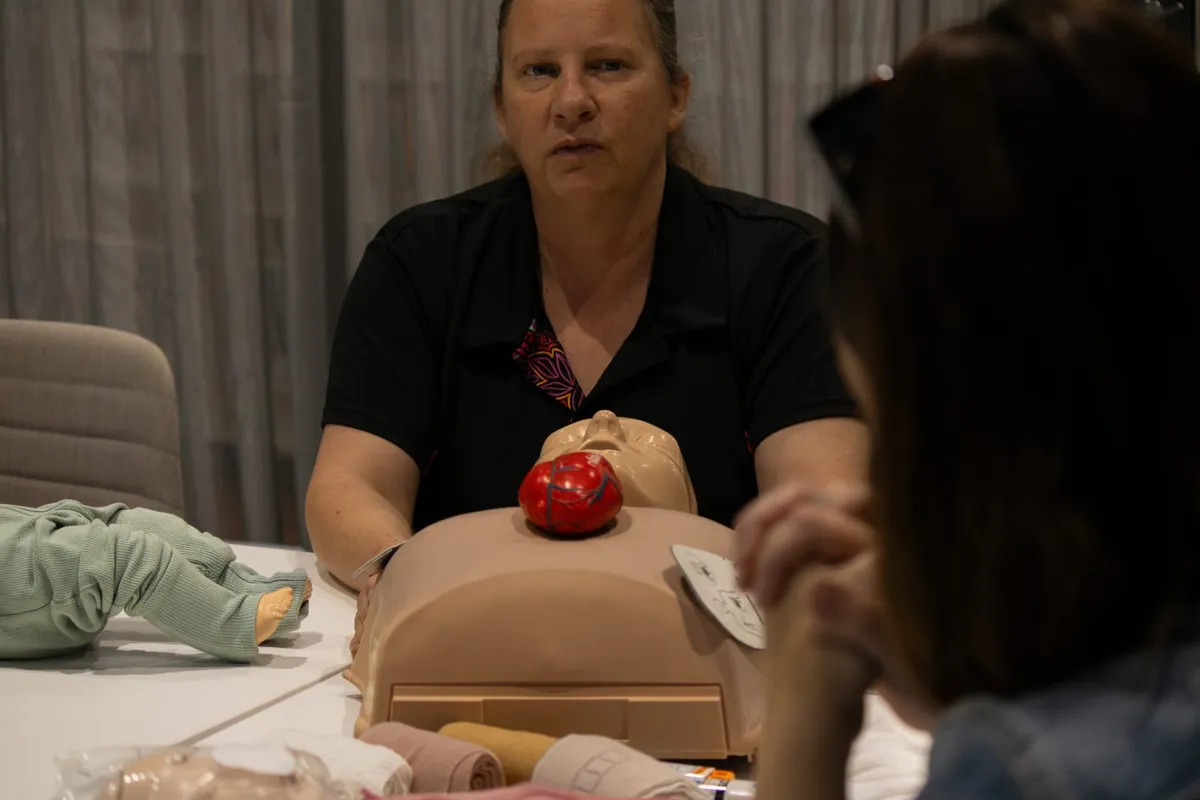
- Use practical, hands-on training. Reading a policy is not the same as practising on a manikin.
- Keep skills fresh. Review training regularly and check competence, not just attendance.
- Support each other. A choking emergency is frightening, and no one should carry it alone.
A swallowing assessment and diet planning for residents sit with the clinical team. A first aid course does not replace them, and this article does not either.
Looking after the team afterwards
After a death in care, staff, families and other residents can all be affected. It is normal to feel shaken, to replay the day and to wonder what could have been different. Our guide on looking after yourself after giving first aid explains what is common, what helps and when it is worth seeing a GP.
Frequently asked questions
What should I do first if a resident is choking?
Check for an effective cough. If they can cough, encourage them to keep going and stay with them. If the cough is weak or absent, send for an ambulance and give up to five back blows, checking after each.
Are abdominal thrusts still taught for choking?
ANZCOR does not recommend abdominal thrusts, including the Heimlich manoeuvre, for first aiders. Back blows and chest thrusts are the recommended method.
What if the resident becomes unresponsive?
Call 000, start CPR with 30 compressions and 2 breaths, and use an AED as soon as one is available. If the person has a known and valid not for resuscitation order, follow your service policy.
What did the coroner recommend after these two deaths?
The coroner recommended that the Aged Care Quality and Safety Commission consider consistent minimum training expectations and competency checks on choking risk for kitchen and nursing staff, and that the board of the international dysphagia diet standards initiative consider how gelled bread is defined. These are recommendations to consider, not mandatory rules.
Is this finding the current rule for all aged care homes?
No. The recommendations are for national bodies to consider. They are not a law or a standard. Always follow your service's current policies and clinical guidance.
Does a first aid course replace a swallowing assessment?
No. Swallowing assessments and diet planning are clinical decisions. First aid training teaches you how to respond if choking happens.
Sources and current guidance
- Coronial finding: Inquest into the deaths of Dimosthenis Gesios and Maureen McGreevy, Coroners Court of NSW
- ANZCOR Guideline 4, Airway
REACHAU first aid training focuses on understanding what to do, why it matters and how to act when someone needs help.
View upcoming first aid sessionsTraining and Assessment is delivered by Britt at Regional Education and Career Help Australia on behalf of ABC First Aid RTO 3399.
Related reading
- Choking first aid for adults
- DRSABCD: the first aid action plan
- After the emergency: looking after yourself when you helped
This article shares learning points from a published coronial finding and current ANZCOR guidance. The recommendations in the finding are directed to national bodies and use the word consider. They are not mandatory standards. This article does not replace clinical advice, a swallowing assessment or hands-on training. In an emergency, call 000.